Episode Transcript
[00:00:00] Speaker A: Foreign.
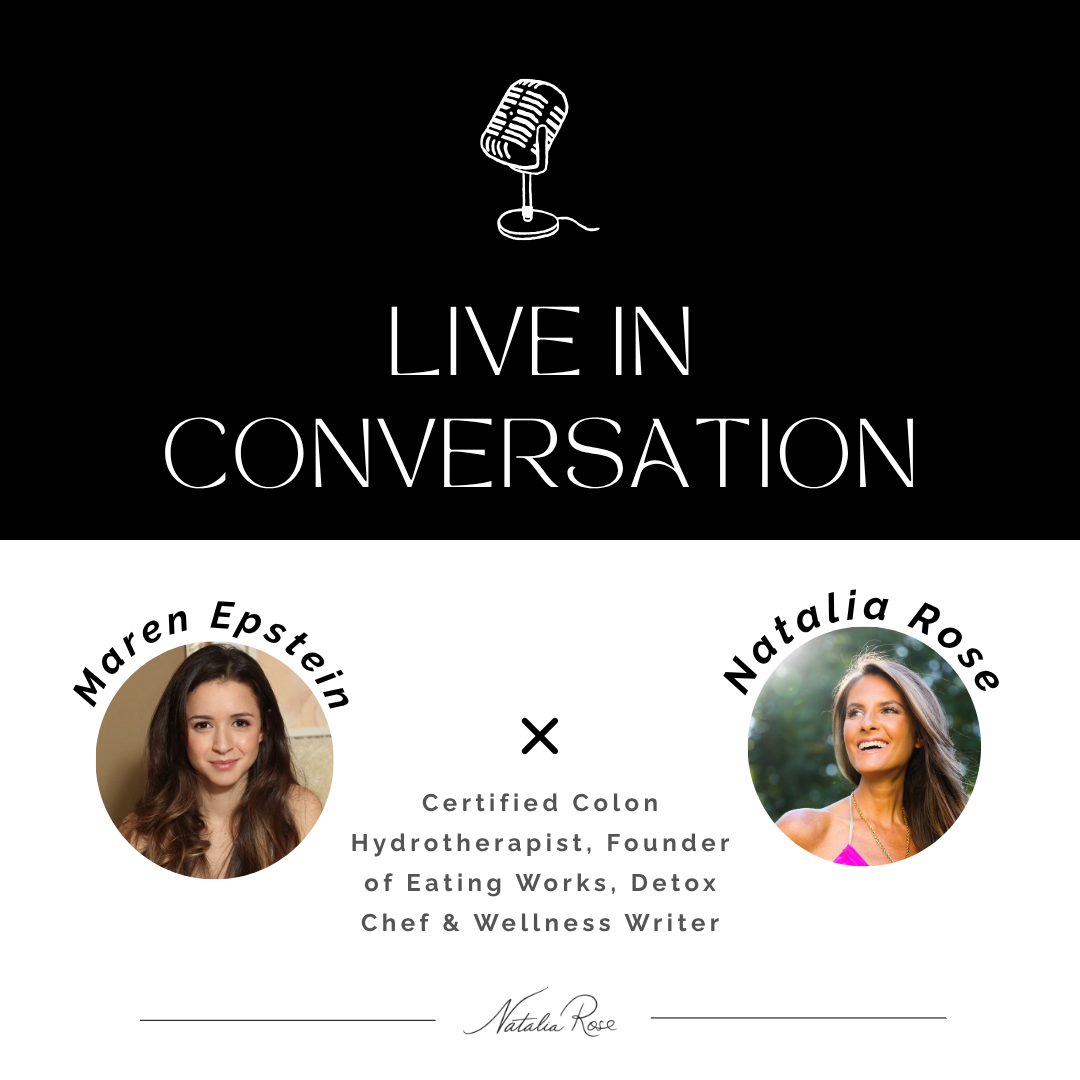
I'm here with my dear friend Maren Epstein. I can't wait to share her with you. Marin is a highly accomplished massage equestrian, wife and mother to 6 year old Ava. The best friend anyone could wish for.
Have to pop that in there and sought after colon hydrotherapist in the Southeast.
Maren is the colon hydrotherapist to whom I send every one of my clients in Florida. I am so grateful that she is here doing this miraculous work for everyone undertaking the cleansing path in this area as there is such a huge need and she is completely booked up. So we are lucky to snag her today for this special conversation. Maren is a health supportive chef with a degree from the Natural Gourmet Institute which is a part of the Institute of Culinary Education.
Maren also holds a Bachelor's degree from Drew University in Art History, Museology and Economics. Maren specializes in developing gluten free diets and recipes for gut health. Maren's recipes are also predominantly plant based, paleo, vegan and free of dairy and soy. All of Maren's recipes are designed to support those on anti inflammatory and gluten free diets. Maren has published food pieces in the New York Daily News and the Independent, along with many recipes for mashed health, wine tasting table and more.
Maren has extensive experience in the alternative health field as a licensed massage therapist and colon hydrotherapist. In practice for 15 years.
After healing from autoimmune disorders through the use of radical deep tissue cleansing through cleansing diet and colon hydrotherapy, Maren went on to train with master cleansing expert Gil Jacobs to learn the art of colon hydrotherapy and tissue cleansing directly from him.
Maren has a private colon hydrotherapy practice in Boca Raton and Miami Beach. Maren, thank you so much for joining us today. It is such a gift to have you.
[00:02:00] Speaker B: Thank you so much. I mean I really. The bio sounds impressive, but it doesn't feel like much to me. But it all stemmed from you. I mean, I went to you when I was 18 for that first consultation and the rest was history.
So sure, you.
You lit the match and I ran with it. But if it wasn't for you, I don't even know if I'd be alive today, let alone living in a vibrant body, feeling good and able to help others. So I'm very grateful for not only you as a practitioner, but also your friendship.
It's been awesome bonding with you down in Florida and I think we've been having lots of fun.
[00:02:33] Speaker A: We have. It's you're you're my family.
[00:02:36] Speaker B: Same soul. Family.
[00:02:37] Speaker A: Awesome. Yes.
And so. So it was 18 on 17, but nevertheless, it was very early stage.
Yes. Thank you for. And.
And so maybe let's begin. Tell us a little bit about the story of you coming to the cleansing work and why you were called to it and how it changed your health
[00:02:56] Speaker B: and your life course.
[00:02:57] Speaker A: Sure.
[00:02:57] Speaker B: I'll try and give you the elevator pitch because it's such a long story, but essentially, when I was in high school, I always suffered from, like, chronic inflammation, a lot of old injuries from being a gymnast. Like, my nickname in high school was Grandma. I was always sick.
I had arthritis, and on top of that, I had migraines, bad digestion, and all sorts of stuff. And then as soon as I got to college, all of that just kind of 10 times and got so much worse. I.
I not only started just having headaches, but I started getting migraines that looked like epileptic seizures up to four times a week, where my face would swell up, especially on the right side, which we'll learn is connected to the colon cecum.
I would lose vision, convulse, lose control of my body, see auras, and it was in incredible pain. So if I didn't have one of these migraines, or if I wasn't completely knocked out from recovering from one, I had pressure headaches. And on top of that, I had pmdd, which is really bad pms.
[00:03:58] Speaker A: So.
[00:03:59] Speaker B: So for two weeks out of the month, I had symptoms from your normal PMS all the way to depression, anxiety, stomach upset, all sorts of stuff. And then on top of that, I had ibs, C, ibs, C. So ibs, constipated type. I think I maybe went to the bathroom my whole life, once every four days, if that. And my stomach always hurt. And I noticed how when my stomach hurt, I would start to get a migraine. And if I went to the bathroom, if I took a laxative. Because of course, like all other young women who are sick, I developed an eating disorder. So I started trying to restrict and control everything I consumed because I noticed certain foods may be ill and certain ones didn't, but there still didn't seem to be a rhyme or reason. I couldn't put my finger on it. All I knew was that when I didn't go to the bathroom, I got migraines. If I took a laxative for four days, I didn't have a headache.
So I went to doctor after doctor and asked them, is my stomach related to my head? And they would say, absolutely. No, not at all. It's whole hormones. You have spots in the. I went and had an MRI and there were spots in my brain. So they were like, there's something wrong with your brain. There are spots. We don't know what it is, but we'll put you on some epilepsy medications and vasoconstrictors.
So I took epilepsy drugs for a while, and that created a whole new layer because it did control the migraines to an extent end. But it also dulled my senses. So instead of taking, like, I took art history classes. So everything was.
It was a lot of information and note based. And I always took around 10 pages of notes per lecture. But I noticed on those drugs, my notes went down from 10 pages to three. And the one area of my life I felt like I had control was my grades. I had like a 3.0, 4.0. And so to see that drop was horrible.
So I went off of it and I was just suffering. So I was literally in a bookstore and I quite literally tripped over Natalia's book, the Raw Food Detox Diet. It was on the floor and I picked it up and I was like, this is different. I read it cover to cover in like a day. And it talked all about how, you know, the body is a perfect machine in order to get rid of. To function, we just have to clear old waste like a car if there's a clog or plumbing, like, it can't function. And I said, wow, this is different. Everybody always talks about what goes in, not comes out. And I've already tried all the other kinds of diets. I gotta call it.
So I called her. She was on sabbatical. Long story short, I got in, thank God, and she put me on a diet and sent me to Gil Jacobs, her teacher, one of her teachers. And he saved my life. I saw him. I did whatever he said for five years. I saw him every maybe five days. And I got a home unit. I learned how to use it. And over time, I started to slowly get better. Instead of feeling terrible for seven days, I'd feel terrible for six days. Or I'd have three hours after a clonic where I felt clear, sometimes only an hour. But then what Gil and Natalia both described to me was that as the reason I felt better after clonic was because my body was finally clear and it would just fill back up with waste again. Because, you know, the body cleanses like a sponge. If you have a dirty, like, let's say you wash your car, you dirty sponge and it's filled with mud, but it gets dry, it's still light. And you put it in water, it fills up, it hydrates, you wring it out, you lose some waste, dries out again, and then you dip it again in the water again, wring it out, more waste comes out. So like we're constantly cleansing the body by wringing it out, hydrating and ringing and hydrating, ringing. So on the ring, that ring, I would feel better, but again I'd feel my, my organs would fill up with waste again so quickly that I need another clonic.
So I noticed and was told that over time I would stay cleaner longer and my body would get stronger and I'd start to feel better for long periods of time. And that did happen. It took years.
But I was relentless with the work. I never gave up. And I just kept going at it. And I think if it wasn't for Natalia's guidance and really, honestly, at some points, tough love, I wouldn't have stayed the course. And I'm really glad I did.
So for anybody out there who's just in the weeds, just if you've had any sessions or any luck where you've started to see the light or feel the lightness, as we say, keep going. There's more on the other side, but it's, it's a long process and unfortunately there isn't walls and walls of text from Harvard Medical on these methods. So it's, it can be hard to stay the course, but the work is true.
Through my own practice, I've seen so many people get better from things I could have never even thought of. I'm trying to think of ones to share with you now, which I will. But that's how I got better. And back to my point, I was graduating from college and I didn't know I was going to be an artist, an art historian. And Gil was like, you know, you have a really good story. You stuck with this work. I think you'd be a really good practitioner. And I was like, I don't know how I'm going to tell my in laws at the country club about my job. So I had some trouble with that. But once I got over and I said, you know what, I want my lifestyle to be in line with my work. Like, I want to just live in pure alignment.
So that's when I agreed and he agreed. I was lucky. I didn't realize how lucky at the time I was for him to train me. And then I worked under him for a year before starting my own practice. So I really got the best five star, not only healthcare, but training I could have ever asked for from both practitioners, Natalia and Gil.
And which is why I still work today. I feel like it would be a shame not to share it.
[00:09:21] Speaker A: Wow, what a story. Maren, thank you for sharing that and all the. All the details. And I've got lots of questions, questions for you. But, yes, thank you for continuing to do the work because you are a busy mom. You are the equestrian. You have a lot that's going on, but it's, It's. You do this with love. It's. I mean, you drive down to Miami.
[00:09:39] Speaker B: Yeah.
[00:09:40] Speaker A: Because you could. You could just live a very, you know, comfortable, happy life doing whatever you enjoy with your horses and your. Your family.
[00:09:47] Speaker B: I could just go to tennis,
[00:09:50] Speaker A: you
[00:09:50] Speaker B: know, but I'd rather do this.
[00:09:54] Speaker A: So are you asymptomatic now? And how far along in the. In that duration of cleansing, when you talk about the years, did you start to get a sense that this was going to stick long term? Because obviously if it took years to get to that point, you probably wouldn't have. Did you start getting indications sort of earlier on?
[00:10:15] Speaker B: Yeah, I mean, at first, no. Like, it took a solid six weeks. But I also was getting colonics at another place where. Where they weren't effective, so more waste was getting picked up and was coming out. So I was getting more symptomatic from the sessions.
But I think that was actually also an indicator that there was a lot of waste in there that wasn't leaving. So I understood that. But the light bulb moment was really one of my first clients with Gil.
I had a really bad migraine. My husband, boyfriend at the time, like, carried me into the office, put me on his table, and I had a great session, the cecum release. And I could literally, I remember watching the tube and him going, oh, see, come. You know, I saw like, just like 15ft of blackness come out of me and, like, all the pressure around my head just drained at that moment. And the migraine went away. And that was the only light bulb I needed. Just seeing the immediate effect and feeling it in my own body was like, I was just.
Health is so much simpler than people think it is. This is it, you know, sure. When you get into the nitty gritty of what causes what symptoms and this and that, sure. But, like, at the end of the day, like, the body is a whole organism. It cleanses as an organism, and when we allow it to live in a clean system, it can function.
So it was just. So it's so simple to me. And I think those simple truths I really held onto. And also the. Well, what was my other option? Like, I had an eating disorder. I was on drugs. I felt terrible.
All the other diets didn't work. Like, I was out of options. And that's why I always say colonics are the therapy of last resort. A raw food diet is the therapy of last resort. It's the hardest work, but it's the work that works. And it's usually truthfully the last thing people come to.
It should be the first, but it's like the thing people try, like, last most people.
[00:12:07] Speaker A: Yeah. Very concisely. Well put. That's so true.
And.
And then in terms of what you've seen in your practice with others and what happens when the waste is released from them and their tissues open up and the energy can flow.
[00:12:25] Speaker B: Oh, my God. I've seen so many things thinking off the top of my head.
Well, one that was interesting.
I can talk a little bit about infertility, but one that I thought was really fascinating was I had one client who came to me every 10 days for like eight years.
And I remember when he called me, I was actually standing on my wedding venue, like, looking. I must have been 22.
And he had chronic yeast infections for years, was depressed and on medications and had. He had 99 allergies. I remember looking at his allergy test, like, wow, you're even allergic to termites. He started coming to me every 10 days. I.
We were doing all the things for yeast, the yeast diet, which, if you were following Natalia, familiar, no sugar, this and that. And we were putting hydrogen peroxide in the tank, which you're not really allowed to do anymore. We were just like, coming at it from all sides. And literally the first clinic I gave him, the entire tube was just filled with like, white cottage. He was just full of it. And then fast forward a year, he felt intensely better. Like he used to only be able to function off of Chinese herbs that he would get from Chinese doctor, like every 10 days to the point where he was off of all of his herbs.
And he got an allergy test and he only had two allergies left, dogs and cats.
So that was really cool.
The most. The funniest colonic story I have comes to mind today is I have a client who is very dear to me. I don't know if she'd want me to share her name, but she.
I've had a few, like, pregnancy things, like four people who've gotten pregnant who couldn't both to buy IVF transfers that were successful after, like, one to eight unsuccessful transfers and two naturals. The first one was a client who came to me with pancreatitis. This girl was 5, 10, and, like, 100 pounds. I mean, she looked sick. And she was a nutritionist, very educated, had a flower company.
Amazing woman.
But the pancreatitis, like, ruined her. And, you know, I always said to her, I was like, well, you know, you probably constipated. That's why you can't gain weight.
So. And, like, all this waste stuck in the flexors around your pancreas is choking the pancreas, causing it to spasm. So let's, like, create some space around it and see what happens.
So I got her on the juice and a cleansing diet, and she started coming to me clients once a week.
Within, like, I think, like, eight months, the pancreatitis was gone. She had no more symptoms. She wasn't on drugs for that anymore. And she put on a good. It looked like ten pounds. She looked way better. So then she just kind of became a regular client and friend. I saw her once a week the whole time I lived in Jersey. And then she got sick again, like, three years into the work, and we didn't know what it was. I was calling Gil, like, what do you think it is? Do you think it's mold? Like, this is just so unfamiliar.
And then one day, her mom just goes, are you pregnant?
She's like, there's no way I'm pregnant. She needed IVF for her first two, and that was five years before this. Like, she'd gotten older. There's absolutely no way she could be pregnant.
Took a pregnancy test, and she was pregnant. Turned out it was a DNS, and she wasn't unhappy about that. She didn't want any more kids. But the fact that her body could then get pregnant after years of illness and infertility was such an amazing thing.
So then time passes, and another client comes in, and we start talking, and we had a lot of mutual friends. So it turned out that she was related to this new client of mine through a friendship. Like, this client had set her up with her husband.
Call her Julie.
And so I told my other, the original client, Amy, that Julie had come for cloning. And she called her up and said, oh, you know, just be careful. You could get pregnant. And Julie laughed at her because they did fertility.
They were in support groups together for fertility for their second children.
And within a month, she was pregnant. And the baby was born on my birthday.
So that was pretty cool.
Then there were two others. One of my clients is another health supportive chef from the Natural Gourmet. We worked together teaching cooking classes and catering. And she even wanted me to change my email address because she was like, nobody can know that you do colonics when we're doing food. That's weird.
But she wanted a second child and it wasn't really working. She had around eight miscarriages and failed transfers. And I said to her, like, just come to me for colonics. Like, give me like 90 days of coming, three days, three times a week. I know it's a lot. You don't pay me, let's just try it. Because it's really almost like you or me.
And she reluctantly agreed. After six weeks, she tried another transfer. And I said, I don't think it's going to work. And it didn't. But then we kept going for another three, for a full four months, I believe it was. And she had a successful transfer and another baby.
And then the fourth one was a dear friend of mine that I grew up riding with, who went. Who lived in San Francisco, so they weren't even near me. But they had spent hundreds of thousands of dollars on failed IVF attempts and to the point where their doctor in California fired them and then sent them to a doctor in Morristown, New Jersey, which was close to where I was. So since they were staying at a hotel nearby, you know, they came to my house for a barbecue, we went to dinner, and of course I had two glasses. One started telling them, well, you know, and started into my whole spiel about colonics and why if you're going to get an IVF transfer, you should obviously get colonics.
And they were like, you know, honestly, that makes sense. So she came to me right before the transfer. She. She must have thrown down like 10 pounds of heaviness. It was insane. Amazing colonic. And she carried a lot of waste in, you know, right above the pubic bone, like in that area that puts a lot of pressure on uterus and the arteries, where if you have a lot of pressure on those organs, those organs are meant to float in space. The floating tubes have to float in order to release an egg. The uterus can't have tons of pressure on it, then it can't hold the baby. If the blood is dirty, then the lining that the baby sits in is going to be dirty, blah, blah, blah. So all these things. So she had this great clonic, took so much pressure off, and then the transfer was successful and she had baby. So Those were a few really cool stories. The rest, my run of the mill, bread and butter stories are acid reflux, chronic lung issues, skin issues, and of course, candida. Those are the things that, like, I clear up day to day with clients that are just fun, easy.
[00:18:50] Speaker A: It's like every day it turns around every day.
[00:18:54] Speaker B: Yeah. So, yeah, like, even my mom, you know, when you saw her, she was coughing and you were like, you got to do three clients a week. She now been coming for three weeks at three clonics a week. I haven't heard her cough or wheeze in.
In like a week. And that was only in two weeks. So, like, acid reflux is my favorite. That's the easiest to fix because most women, if you've heard of the concept of a prolapse transverse colon. Right, Like a prolapse transverse. So like the part of the colon that sits here above the solar plex, as it fills with waste, it kind of goes like this.
It starts to sink, or if it doesn't sink, it gets full and it puts pressure on the stomach. So then when you eat food, it almost acts like a trampoline. It bounces the food out of the stomach and right up into the esophagus. So it creates constant gerd before it sinks. So once you release that transverse colon, the acid doesn't lap back up into the esophagus and they feel better. So that's always fun.
[00:19:45] Speaker A: Really well described. Thank you, Marin. That's awesome.
[00:19:47] Speaker B: I try it, and I'm trying not to, like, meander too much.
[00:19:50] Speaker A: No, it's perfect. These are the examples because you're there. You're there on the ground, in the terrain with them, making the change in real time.
[00:19:59] Speaker B: Just the mechanic, the bio organic plumber.
[00:20:01] Speaker A: Yeah. But you're seeing it to inspire those who are listening who may be beginning this process and don't even really know the power of it the way we do. To be able to impart that to them and to know that the skin, of course, is going to clear up when the colon empties and the body, the tissues can start to release. All the.
Maybe speak about the skin for a moment, if you don't mind. As well as weight and weight loss, because that's another one.
[00:20:26] Speaker B: Oh, yeah. I always talk about health, but to be honest, I mean, most of us come to the work because we want to be hot. Right. Like, it's fine. And I don't care what brings people to the table, whether it's vanity or health, because you're gonna get both.
But I mean, look at Natalia, look at me. I'm not trying to be vain, but we don't look terrible. It's because we don't have waste, like literally rotting within ourselves. But basically, the skin is the marrow body. It's the largest eliminatory organ we have, but it's the second most important limitatory organ. The first one is the colon. Right? The colon holds all the waste product, basically, because when we drink. Let's just start with water. When we drink water, it doesn't go to the small intestine of the stomach, goes right to the colon. And it gets absorbed through the walls of the colon into the bloodstream. And that's what hydrates the blood so that blood can go around bringing nutrients from the small intestine, two cells, and then away.
So basically, what the colon. Think of the colon as the city dump. The blood as the streets, with the blood cells as your delivery men and garbage men. They take, bring stuff and take it away. And the cells are the houses, right? Your house is everywhere.
And what, what happens is the blood brings nutrients and groceries to your house, and then it takes away the garbage, then it dumps the garbage into the city dump, which is colon. But when the colon is full and when there's permeability in the lining of the large intestine people call leaky gut, then all the waste from the dump is still staying in the blood. So it's like the garbage truck is full. There's nowhere for the waste to dump, but the body has to put it somewhere. So it starts going through the back door. If the colon is full, the back door is the skin, the secondary limbatory organ. So if you have waste, it's not leaving the body through the colon. It's still in the blood. And it's going to come out of the skin anytime there's stress, anytime you're sweating.
So that's when you're gonna have anything from, you know, eczema, psoriasis, acne,
[00:22:25] Speaker A: your
[00:22:26] Speaker B: everyday common rashes that doctors. And the reason, and that's why doctors give steroids for ashes, it's not that the steroids actually get the rash away. What it does is it pushes the infection back into the skin to bloodstream.
So when you clean the colon, then the blood then becomes cleaner because the water that goes into the colon then can go through the lining and not pick up bacteria toxicity, old waste and bring them to the bloodstream. So your blood just becomes way more effective at taking waste product away. So then the waste no longer needs to go through the back door, which is the skin. So you know, I've seen people with psoriasis, eczema and acne clear up quite easily even in myself. Like I went, Natalia is going to think I'm crazy. I went on like a three month experiment where I tried bodybuilding and I increased my protein intake, which was still vegetarian. But my skin looked so bad, like pink, red, rosacea, inflamed, all of it. I thought I was just like, I was like, I'm going to have to go to the dermatologist and like take the normal route. This is, none of this is working. And then as soon as I just like gave that up, went back to just pure juices and one meal a day and couple of clonics a week, it'll clear up.
So now if I ever break out because I don't wash my hands and touch my face and go to the barn and ride horses or from getting any hormonal, maybe like one pimple if I'm getting my period or something like that. But I've had, not had skin issues other than from chronic inflammation and not taking care of myself when I know I'm not taking care of myself in since I started the work.
Yeah. And just for Every. I'm almost 35, so that's just for people as a reference.
[00:24:04] Speaker A: Yeah. I know you look like you're 22 and I still think of you as like, you know, you're 18, but it's. Yeah. You are a bona fide woman of 35, wife and mother.
[00:24:14] Speaker B: People do think I'm a kid. Like when I'm riding the horse, like some guy was standing there and he goes to one of my friends, that's a good little rider and she goes that, that she's got a house, a business and a kid, 34.
So yeah, it's partially the. And the work keeps you looking young. I mean I get so skewed on people's ages because my clients all look so good and so young that honestly like that's the biggest sell. Like when people see other clients walking in and out of my office, they're like, damn, I don't look like her.
And that's really what does it right.
[00:24:45] Speaker A: You're not doing anything to them. Topically, it's all internal.
[00:24:47] Speaker B: It's. But that's the whole thing. It's all internal. People think that everybody in this world that was like the Americanized mentality put her inner mentality. What can I put into my body to make it function? What could I put on my Skin to make it better.
That's not what it is. It's the taker outer mentality. What can I take out of my body so that it can function off of its own internal energy?
[00:25:09] Speaker A: That's it. That's it.
[00:25:10] Speaker B: Because the body's all. Yeah. The body's always trying to get rid of it.
[00:25:13] Speaker A: Yeah. And the second you let it out then you're the infinite intelligence just operating and flowing and conducting and you know it's going to be beautiful because that's what it does. It's in nature devices is always exquisitely
[00:25:25] Speaker B: beautiful and I've never met somebody who got fat off of salads and I never met somebody with bad skin. Who does this work for? Who does this work properly?
Yeah, consistently consist not only consistently but also properly. That means eating a diet that's appropriate with the amount of waste that they're eliminating. Not over cleansing, not under cleansing.
And that's where. And that's what. And that fine tuning is what's hard. And that's why people like Natalia are great. Because it's really hard to identify that line yourself when you're in the middle of it. And also you need somebody with lots of experience who could say this is too clean. This is too the nuance of the work. It's very helpful to have a who can guide.
[00:26:04] Speaker A: Thank you for clarifying. That's so important because the principles are universal to all. It works for everyone.
But the fine tuning is where the tailoring, the customizing comes comes in where everyone is different. Everyone has different taste and waist load and ability to release it. You know, access to therapist enlightener and enema their sort of facility with changes over time. So you have to know where you are in the whole trajectory and not to go too fast.
[00:26:34] Speaker B: 100 I mean the diet that would be good for like a 17 year old person who grow up in South African if the environment would kill the geriatric patient with multiple system juice. So it's really just about finding where you are in the scale. But the universal principles do hold true. And then in terms of weight loss, I mean Natalia said the best weight is waste. Right. Touching on that topic. So like our bodies are pack rats. Like we were like literally hoarders. If our body doesn't know how to process something because it's not natural, it's not in our DNA, we literally save it for later. Because the body's goal is to keep the vital organs open and clean so that it can function. Right. Like your lungs have to be clear. You can't have blockages in your arteries. So we put the waste where we don't need it. Fat vacuoles, the body will store toxicity in your thighs and it might look like cellulite, or you might have internal waste and pressure, which will cause varicose veins and things of that nature.
Your ability to get fat in a way is really saving your life. It's taking that toxicity and keeping it away.
So what the diet does is once you start, like, I never counted calories since I started this lifestyle, and I mean, I'm 97 pounds soaking wet, and I ballooned up to 108 when I was bodybuilding and putting on muscle. So, like, you stay lean in this lifestyle and keep in mind I'm short, I'm only five foot. But my point is, when you see the heavy people who are walking around feeling fine, it's because all that toxicity is in the fat cells. It's not in their vital organs, so they can function.
What the diet does is it literally starts magnetically pulling waste out of the fat vacuums of the cells and into the inventory organs.
So you're literally juicing your fat cells by doing this work.
I mean, it's a completely different way of losing weight. It's not calories in, calories out.
That works too, if you can manage it. But you're not going to look the same. I mean, I've seen people in the gym lose tons of weight and get really lean and they almost like look dead. Like their skin is like sagging on the bone. They have so much nitrogen in their, in their skin. Whereas, like, what we're doing is we're taking waste away. So we're literally almost like shrinking the cell. And then we're also bringing more oxygen into the cells, so we're plumping in a way. So it's, it's true waste loss, which looks like weight loss.
And that being said, the diet will level you out. Like, I've had clients who were severely underweight who gained weight and clients who were overweight, loose. So wherever your body's meant to be, it'll kind of just put you there.
Like, when I had an eating disorder, I was literally scared because I knew that going for the clients was going to put weight on me because it was going to fix my absorption issues.
[00:29:13] Speaker A: Well, I can tell everybody you have the most salam and figure you're very gentle.
[00:29:19] Speaker B: So do you.
[00:29:20] Speaker A: All right, well, thank you. But you're. Honestly, when you wear your little crop tops and your things, like, you just, you really wear them.
[00:29:26] Speaker B: Listen I'll take your. Your body for a test drive anytime. It's great.
[00:29:31] Speaker A: That covered a lot of ground. And thank you for sharing all of that, both on a technical level as well as an inspirational level. Let's talk about recipe development, and that's part of what. What keeps people on this long term, because you want to love what you're consuming and, and know that it's going to be really satisfying. Everything. So what made you feel like you needed to explore that? Was it because you wanted to be able to create meals that you would love long term? And then how did it translate into it being a big part of your career? And then can you just. Just by the by, also share some rescue development hacks with us too?
[00:30:06] Speaker B: Yeah, absolutely. So basically, when I went to culinary school, I had my practice in Hard Slope and would recommend, you know, food combining and, you know, no oil and all that stuff. But. And I tell people what to eat, but I didn't know how to tell them to make it taste good. And women, you know, we all are emotionally attached to food. Like, men don't have the same thing. But, like, for us, eating is like a sensual experience. And in order for this lifestyle to be maintainable, for most, like, there has to be satisfaction. If you're not satisfied, you're not going to do it. I wanted to learn how to do both, and I decided to take a sabbatical for my practice because I lost my aunt, who was basically like my mom. So I was like, well, I always wanted to do this and started food blogs. Now. Now's the time.
So I went to school to learn how to cook. I mean, I literally didn't know how to cook. I barely knew how to boil water. And my meals were very simple. I took like, a box of roasted beets, put it in a box of lettuce, put some goat's cheese on it, shook it up with some lemon, and that's what I ate. Like, nothing was very exciting, but I loved going to Pure Food and wine and eating all those elaborate meals. And, like, I just wanted to learn how to do that and how to tell my clients.
So that's what I did. Went to culinary school. And then I started just taking the universal principles that I knew and utilizing that towards recipe development. And that's how my food blog was born, Eating Works.
And on that website, I have recipes for every level of lifestyle. From a grandma who had knee replacement surgery, who needs to lose a little bit of weight, feel better.
So we're talking like, chicken and rice soup, like, simple stuff all the way down to the cleanest of the clean. Making cheese out of seaweed. We do it all. But some tips that I could share really is that as long as you have a good dressing and a good dip in your refrigerator, all vegetables are satisfying.
So you just have to have a few of those and you are good to go. And in terms of developing them, I always follow rule, which is for sauces and dressings is a 2 to 1 ratio. The traditional ratio would be 1/3 acid to 1/3 fat to develop any recipe for a dressing. So that means like if you have, you guys don't do oil, but if you had 3 2/3 cup of oil, then you would have 1/3 cup of lemon juice or vinegar or something like that to make everything lighter and cleaner. I swapped that for 50, 50. So 50% acid and 50% fat.
So instead of using oil for any kind of sauce, what I'll do is I'll use tahini or avocado as a base.
And there's a lot you can do from that. Like there are a few links I could share for you. Like there's this one green tahini sauce that it. Oh my God, like you don't even know how good it is. Like literally you could drink it. Even make one hot sauce that acts as a dressing out of celery. Like there are so many ways to create delicious dressings using miso, nutritional yeast, tahini, avocado as a base water, nama shoyu soy sauce. Like there's a lot you could do without using oil.
And if you eat, you can do both. And then in terms of desserts, I mean I have sweet tooth, but everything on my blog is pretty much keto. So what I do is I make a lot of desserts. Like I'll make a lot of chocolate truffles and things like that.
But instead of using dairy, I'll use the fat of coconut can. So if you need something creamy, you just throw a coconut can in the fridge for two hours and then scoop the top part off, throw that in with some melted dark chocolate chips. And you could do one tablespoon of butter if you're eating butter. And then instead of sugar, I just sweeten it with like 2 tablespoons of monk fruit sugar or stevia. It doesn't have an aftertaste. And that solidifies into like the most delicious nama chocolate Japanese chocolate truffles that you've ever had in your life.
And so by using just like a simple monk fruit sugar stevia, like you can really Just like cut that sugar out but still get that satisfaction from like the sweet, nutty flavors. Because, you know, we all need desserts. Like, remember juice press, how they used to sell those seeing through walls cookies? They were made of like tahini and almonds.
Like I make those, but instead of putting agave, I just throw in some, like, some stevia.
[00:34:22] Speaker A: Yeah. I mean, I'll speak from my experience too. I've just needed to have the chocolate something sweet. So it's.
We have to acknowledge like, what, what is it that we really enjoy and desire and then we can get rid of all the other things, keep the things we really like and all at the same time and really have it all.
[00:34:37] Speaker B: We really can have it all. You just, it just, all it does is require like a little tiny bit of work. Like, I think everybody likes those chocolate haystack cookies and chocolate truffles. I make them, they're so easy. Unsweetened coconut, a little bit of tahini or nut butter. You need some kind of moisture if you're not doing oil. So like a nut butter and like La Canada Co. Sells like a sugar free maple syrup sweetened with monk fruit that's actually clean. You can put a little bit of that in and you just mush them up with some cacao powder, let them dry out and you got a chocolate cookie. They're delicious.
[00:35:08] Speaker A: Demo one day, if you have.
[00:35:10] Speaker B: Oh yeah, we could do like a cooking class of like maybe like all desserts. Like, because I mean everything. Like I have a recipe plugin on my website and like a lot of these things are only like 30 calories per serving, which means that there is like no sugar in them.
[00:35:23] Speaker A: Right. That's how we can use calories as a measuring stick to determine the density and the sugar content. So for sure, that sounds amazing. So dressings, dips, knowing you can make yummy desserts, knowing that, you know.
[00:35:35] Speaker B: Yeah, I mean, there's more, you know, like certain things are easy. Like tacos.
I make so many tacos.
One recipe I love. Like, I'll do a black bean sweet potato taco. You know, I don't know if depending on where you are in the lifestyle, if you eat beans, but even if you don't, what I do is like a brussels sprout taco.
So this one recipe is so easy. If you just take some brussels sprouts, pan fry them in either in some unsalted organic butter ghee and lemon juice, they get so crispy and take them and put them in a sate wrap made from cassava that you just warm in the pan, then put that on With Kite Hill makes amazing like nut based ricotta and sour cream, all soy, everything free. Or you can make your own through just some cashews and nutritional yeast water.
You put that on, roll it up and then put it in this tahini sauce that I make with like tahini, avocado, cilantro, parsley, lemon, garlic, salt and cayenne. And it's just like explosive flavor. Like you'll just be so satisfied. And that's really all it takes. I mean, plus also other things like a spaghetti squash. Spaghetti squash. It really does taste like pasta. One of my easiest meals that my regular normal people like is I'll just take a spaghetti squash, scoop it out and then in a casserole DISH I'll do one layer of marinara sauce, one layer of spaghetti squash, one layer of cheese. Do that two times, bake it for 30 minutes for 350.
And it is so decadent. It tastes just like lasagna.
And it's not misconbined. So you could even add it with a protein. If you're eating protein.
[00:37:13] Speaker A: Right. Add a little goat cheese to it if you want to.
[00:37:15] Speaker B: Well, goat cheese. I mean, if your people are eating fish or anything like that, it's a great side.
[00:37:20] Speaker A: Yeah, that sounds amazing. When you mentioned the wrap, the cassava wrap, is that, how do you do that? Is that something you buy or.
[00:37:27] Speaker B: Oh, you buy. So there's a brand siete and I love them. They sell wrap all grain free wraps of different kinds. But the cassava one is really clean because cassava is essentially like a sweet potato.
And it's so easy on your stomach. They're easy. I don't have a client who can't digest them, really.
And you just warm it in a pan and it acts like a regular tortilla.
[00:37:50] Speaker A: Brilliant. Wow.
[00:37:51] Speaker B: Yeah, simple stuff. And like, if you go into like Asian cooking, like they have things like glass noodles that are made of, you know, like sweet potato noodles and things like that. So there are kelp noodles which are delicious.
There are swaps found in ancient macrobiotic cooking or Japanese cooking that you can use to get that satisfaction.
But you know, it does require a little bit of work getting creative, but not much. I mean, I'm pretty lazy, so.
[00:38:18] Speaker A: No, that, I mean that's, that's, that's brilliant. And then yes, the, those noodles, actually I'm glad you reminded me me of them because they really got me across a big bridge. I was always a big pasta lover and they actually Got better over time. Those.
Those noodles, they're made from roots. They're like.
[00:38:36] Speaker B: And they.
[00:38:37] Speaker A: They. They're basically just nothing. They're like nothingness. But they're. They have this consistency to them.
[00:38:42] Speaker B: They're a great dice. They're a great vehicle for sauce.
[00:38:45] Speaker A: Exactly. So you.
[00:38:46] Speaker B: That's all noodles are, right?
[00:38:48] Speaker A: Soaks it right. Sauce.
[00:38:49] Speaker B: We want sauce and cheese. We don't care about the noodle.
[00:38:52] Speaker A: Exactly, exactly. And then. And then even the way it twirls on the spoon, it's like spaghetti. It's so nice. Just have a nice big, hot bowl of that.
[00:39:00] Speaker B: And then I'm probably gonna end up making some kind of ramen with that tonight. Because now that we're talking about, it's getting me in the mood.
[00:39:06] Speaker A: Yeah, it's. But it's. It's so delicious. And if people. When people know. I won't say if. They only know. But if they. When they know.
Well, why would I do anything otherwise? So what's in your juice, Aaron?
I just.
[00:39:17] Speaker B: Oh, this. Sorry. I had to drink it so I could keep talking, but lacinato, kale, celery, apple, ginger, lemon, romaine, lettuce, and cucumber.
Delicious. Yeah, I literally just throw whatever I have in, and then if it tastes weird, I just put more lemon on top. It's fine.
[00:39:38] Speaker A: Lemon and ginger just make everything.
[00:39:40] Speaker B: But my favorite juice really tastes like a pina colada. It's two cucumbers, two heads of romaine lettuce, one whole bunch of cilantro, a tiny bit of ginger, one apple, and a whole lemon.
That recipes on my side, it is literally, like, green. If you threw a shot of vodka in there, it would be. It's mojito. It is amazing. I could drink that every day. Wow.
[00:40:04] Speaker A: Wow. That sounds delicious. I mean, I can imagine how it tastes. Sounds like something I typically make on a regular basis. Yeah.
[00:40:11] Speaker B: And, like, if you want to make it greener, you could throw in a head of kale or something like that. But it's a nice, light juice that pretty much all my clients can drink that I could drink all day. And it's not so green that, you know, like, if you're. If it's hitting waste, where it's going to create a lot of gas.
[00:40:26] Speaker A: You're such a wonderful educator, Maren.
[00:40:28] Speaker B: You're so inspired
[00:40:33] Speaker A: on you right now, so you're very sweet. Thank you for sharing all this with you, with us. And how.
How can I know that you're booked up and there's little chance of anyone Actually getting on your schedule.
[00:40:43] Speaker B: You just have to get. You just have to call me ahead of time.
[00:40:45] Speaker A: Okay. Okay. Calling Maren ahead of time. Where do we find you?
[00:40:48] Speaker B: What's the best way to get to my Instagram, marinetteingworks? My work Instagram is eatingworks. Or my email, marinettingworks. Com, if you need any recipes. Eatingworks.com there's hundreds of recipes on my site.
Because once Covid hit and I wasn't giving clients, I had to do something. So that's when I went into the professional recipe development realm.
[00:41:08] Speaker A: What a gift. So they can literally go on to your website.
[00:41:12] Speaker B: Yep.
[00:41:12] Speaker A: Eatingworks.com and get all these recipes.
[00:41:16] Speaker B: Yep. And they're all organized by nut free, dairy free, soy free, gluten free. You can literally sift and. And filter through.
[00:41:25] Speaker A: Amazing. Maren, what a gift. Thank you so much. Not just for this conversation, but for all you've been doing for the last 15 years. You are everyone. And supporting this lifestyle for people at every stage, you know, it's having the knowledge, having the recipes, having the example, seeing the embodiment. Even as a wife and mother businesswoman, it's like, you know, it's.
[00:41:50] Speaker B: It's.
[00:41:50] Speaker A: You are just such a light.
[00:41:53] Speaker B: And it's high praise coming from a very high place. I appreciate it. And everything you've done for me and my family and your friendship, I mean, was so blessed that I tripped over that book all these years ago.
It was not by accident.
[00:42:07] Speaker A: No, definitely not. Definitely not. And the fact that Gil has also had such a big influence and just the braiding of it all. So that's how it all works so beautifully.
[00:42:17] Speaker B: We're all in sync.
[00:42:18] Speaker A: And when the tissues are open, all can conduct and flow as it should. And when the pathways of life are open, miracles and connections are made. Like this.
[00:42:27] Speaker B: Yeah, exactly. Heart to heart connections.
[00:42:31] Speaker A: Wonderful. All right, well, we will probably have to do a part two of this some point anytime you so excited about it. And. But in the meantime, thank you again. And we will make sure everybody knows how to get in touch with you.
[00:42:44] Speaker B: Thank you. I appreciate that. So just.
[00:42:47] Speaker A: Yeah, be ready for an influx.
[00:42:49] Speaker B: Oh, I'm ready. I mean, I already bought like four more of your books and I just hand them to people. I'm like, just read this.
I talk their ears off and they leave. They look like this. I'm like, just read this book. It's all in there.
[00:43:00] Speaker A: The dream team. Then we're just like, yep, we're together.
[00:43:04] Speaker B: Lots of synergy.
Awesome.