Episode Transcript
[00:00:09] Speaker A: Organic, sustainable and high performing.
You don't need to compromise on your makeup.
My goal was to merge performance, makeup, organic ingredients and low waste practices.
I created kiawise so you can have everything in one beautiful product.
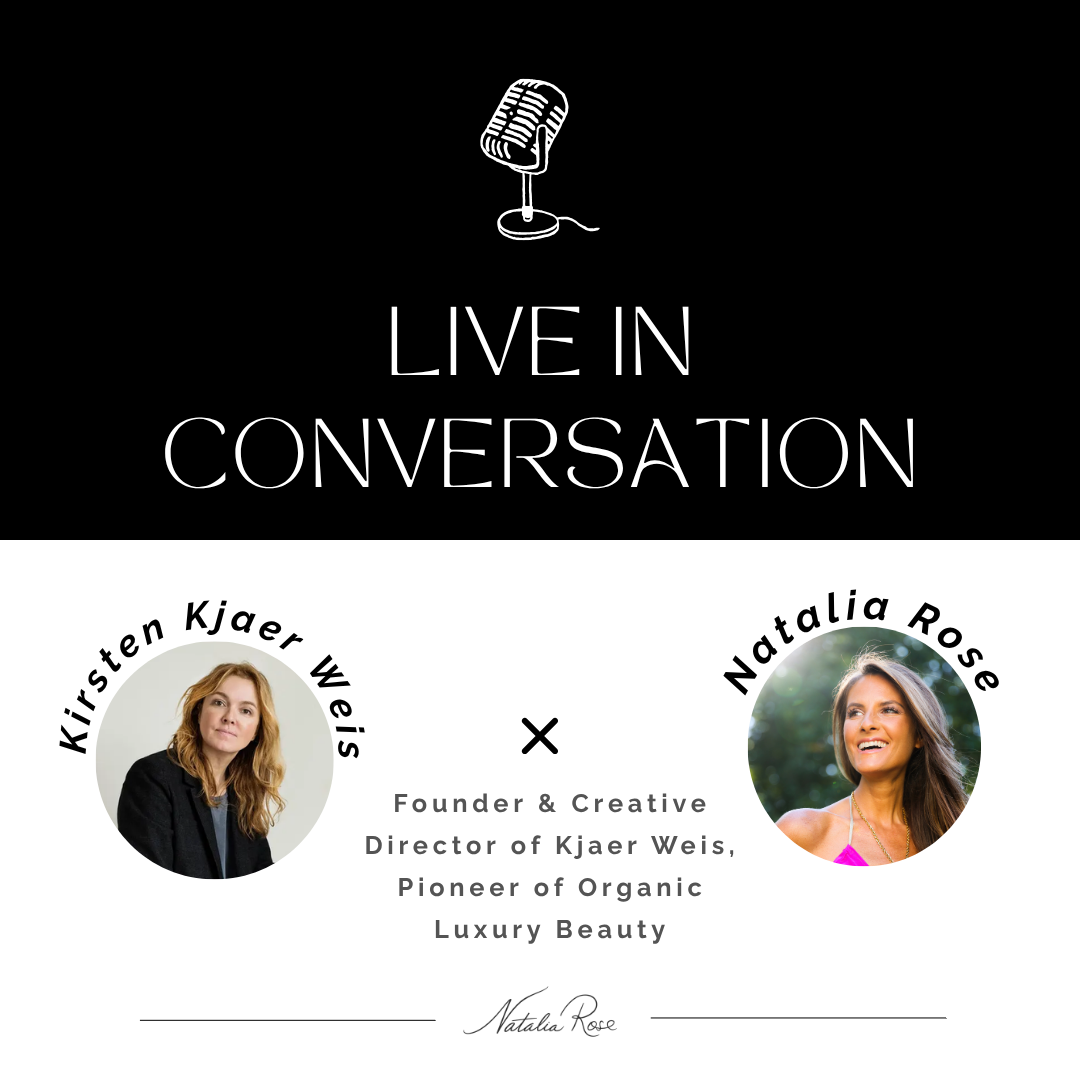
[00:00:33] Speaker B: Okay, everyone, I am back with Kirsten. Kier Weiss. We are so excited to be bringing you part two of this interview. And we realized that it's so many more questions that had needed to be answered and Kirsten was happy to do that. So we're really grateful, Kirsten, to have you here with us to continue this very special conversation. One of the biggest questions that came up was how do we determine what is truly a clean beauty product?
And I thought that's, you know, perfect for you to address.
[00:01:02] Speaker A: Yes.
So I think the overall clean doesn't have a clear framework around it. Some companies that are in the space specifically, I would say retail doors have carved out a framework for themselves where they basically have put together a list of some call it the Dirty Dawsons, the dirty Hundreds. And highlighting the ingredients that from their standpoint really are the ones to avoid. And so whatever is left, they have basically narrowed and laid out very clearly that these are the ones that are okay to have in beauty products.
So I think I don't necessarily. It's very hard to boil that down and sort of say this is clean, this isn't. For some, a silicone would be clean. For some of these organizations, as I was sharing, a silicone falls under clean for me.
It is not necessarily the worst offender. However, it just doesn't fall under clean for me. Is it something to be concerned about in terms of health? Maybe not.
But does it belong on skin? In my opinion, no.
So it's tough to really hone in on it and have very straight guidelines. I personally really go from the standpoint of using natural ingredients and steering away from anything synthetic or just harsher chemicals overall. Obviously water is a chemical, so to say chemicals is not correct either. It's. It's multi layered. As an example, in some of our products, use under 1% of artificial color.
Would I love to keep that out? Yes, absolutely. Is it something we're working on? Absolutely. But in order to have certain shades in the line and to have the inclusivity where you need some more poppy colors for deeper skin tones, it's a must. So it's such a small percentage that I really think it is not harmful at all. But it is something we're working on to get to that point where it's 100% natural. That is the only ingredient, though I will say that we will ever use that is a synthetic, ultimately trying to hone in on it. I would say go to an organization as an example called ewd.org and that's an organization that has honed in and made this their specialty to look at ingredients and do a deeper dive into what they do for the skin and for the environment.
I will share my thoughts on which products, for me personally, fall under clean and within clean, as I know we sort of touched on before. There's still layers.
And this is my personal opinion. In terms of real purity versus clean, there's still different categories. And so trying to do my best in terms of honing in on that. But to give a straight answer is difficult because clean doesn't have a framework around it. It's basically individuals that are determining what they consider clean ingredients versus harsher chemicals. And there's some of the harsher chemicals that are very easy to identify, but then they're the ones that sort of sit in a little bit of a gray tone, like a silicone, for instance. It's a long winded answer, Natalia, but it is a little bit challenging in really honing in on it, really framing it. I hope that makes sense.
[00:04:48] Speaker B: Yeah, no, it does. And I think what's interesting too, there is that there's. I mean, we spoke about this a little bit the other day about how there's a lot of different levels at which people are coming to this. So you've got your absolute beginner and then you have someone who's really transcended any kind of industry standard. They're in their own orbit. Like I would say, I'd like to think that with beauty products, I kind of operate there. It's sort of beyond certain things. Like, I'm not going to just take it because the industry says it's acceptable. Do I feel it's actually resonant with my frequency?
So that's why, you know, it's like a whole other category. But there's some things where I'm still a little bit lost. Like, for example, or a lot lost. I was in Whole Foods the other day looking at shampoos and conditioners and I was like, wait a minute, why is this even here? It has. It's listing fragrance, it's. It's listing. It's not saying it's sodium lauryl sulfate, but it's. It seems to be another three words put together that start with sodium and look like it's sort of that but not that. So is it that. It can be very confusing anyway, so it's almost like where do, where does even someone who thinks of themselves as having a bit of a beat on things begin? So it's almost like there's three levels, like the entry level person, the absolute beginner, what they absolutely need to get rid of. I'd love to know what you think anyone across the board at every level should get rid of what they can kind of slowly maybe let go of. And then, and then we can maybe get to the more advanced transcendent folks who. Of which we have many in this group, I think, who really want to know. Well, you know what? I actually don't even want to play with these pseudo clean products anymore. I only want actually pure according to someone who's not listening to industry standards, but who has their own standard, a higher standard, a transcendent standard. So I'd love to know what you think about that, Kirsten.
[00:06:32] Speaker A: Yes. So just to get back to what you were saying before, like going down and looking for a shampoo and seeing some ingredients on there that seem a little questionable, I really think in that case I would use EWG.org because it's, it's, it's like a bible. You can go in, you can punch in any ingredient, you can see where it comes out on the radar, green, yellow, red. And that's a good guideline to start if you're confused because there's so many ingredients and even some of the ingredients that are wonderful will have some difficult names, if you will. So that way you really get a sense of security when you purchase or before you purchase.
And then I think in terms of diving in, if this is new to you, where should I even start? I have my makeup bag, I have my skincare routine. I've spent a lot of money on this. And so I don't just want to throw things out, which I completely understand.
So I really think it's a step by step process and I would absolutely recommend you start with body lotion. Something that goes on, on a large piece of your body. Body lotion obviously does that deodorant really important as well because it goes straight into your lymph system.
So really making sure that you don't have anything with aluminum in it, et cetera. The body lotions. When I think of in as I was growing up, the volume of conventional body lotions I've applied, it's quite mortifying to think the volume of parabens, et cetera, et cetera. But it is what it is. At least it's long time gone from my routine.
Then I cut out.
[00:08:12] Speaker B: Sorry.
Colon irrigation is going to pull out with. So it's coming decades.
[00:08:19] Speaker A: It's going to take a few years, I think. But very helpful on that front as well. Another thing would definitely be anything that goes on my lips. So any lipstick, any lip balms, anything. Because you will eat it. So very important as well. Another piece would be mascara because mascara, if that's something you use, it goes on.
On basically this close to the eyes and it goes really close to like the skin around the eyes. So that's one that I would recommend as well. Spf.
Anything chemical SPF has to go.
I mean it is really detrimental thinking of what goes into to some of these spf. And they glide on fast and you can't see them and. But take a look at the ingredients profile. Yeah.
[00:09:15] Speaker B: Nobody should be using those sprays, please.
So offensive to everyone around you as well. I mean.
[00:09:21] Speaker A: Yeah, exactly, exactly. I mean you're basically including them in that application as well.
[00:09:27] Speaker B: And children on children.
[00:09:29] Speaker A: Oh my God.
[00:09:29] Speaker B: I have a bone to pick with those spray bottle things. Okay.
[00:09:33] Speaker A: No, I'm completely aligned with you. And I think the last one is probably foundation moisturizer, something again that goes on a large portion of your skin just has to be looked at.
So where can you be a little bit more relaxed? Any. I would say anything that goes on your brows. Anything that goes like a blush potentially, if you have to start somewhere so high of the list. Body lotion, deodorant, definitely spf, lip products and foundation moisturizers and then mascara. So you take sort of your pick of what calls you. But that would be my recommendation.
[00:10:14] Speaker B: So basically just like those little pops of color that you're using, very minimally, you can keep those. But everything else pretty much needs to be checked and repurchased at a higher vibration.
[00:10:26] Speaker A: Yeah, I think so. I mean, you could also like an eyeshadow typically doesn't do too much harm on the eyes. I mean then you would have felt it. It doesn't get super close to the eye. You can keep that as well. It's. It could be a little daunting to look into, but I think don't get too freaked out about it. Do a good check. I have a list of ingredients. If you see that for instance, in an eyeshadow and we talk about maybe you keep that, then I would definitely. That you toss it like the really
[00:10:59] Speaker B: bad offenders thing, like, like the worst of the worst list. That will be fabulous. Yeah. But I think for the members to have that would be gold. Thank You.
[00:11:07] Speaker A: Yeah, definitely. Pleasure.
[00:11:10] Speaker B: Okay. So among.
Because I. I know there are. Well, by now there's a lot of brands in the.
Let's say more, the space that is meant to hold a very high level of integrity of beauty products. So there's a bunch of brands in that category. Would you like to speak to any of those brands or anything you have to say about that? So, I mean, I know that there's. There are a lot of members who are. Who have been looking for a while, have. Have become familiar with a lot of these brands.
[00:11:45] Speaker A: Yes. So I think, again, this is my personal point of view. I am not affiliated with any brands, but it's just from a very long time of using products, using them on myself, knowing what goes into producing products and seeing the dedication and the procedures that will really generate these deeply beautiful products filled with vitality.
So I look at the space of clean with great excitement, frankly. I think that we've made that quantum leap from conventional. Just over a decade ago, really a little over a decade ago, to where it is today is huge progress.
I still think that there are some brands out there that really have their heart and soul in it at a whole different level. And for me, that is tangible. That is a sensitivity that comes through in the way it wears, the way it feels in the skin and the way it performs. But. So it's both short term, but it's also long term. So the short term is obviously the immediate payoff that we need to see, want to see. It has to be there. Otherwise the product honestly doesn't serve a purpose. But then how does it feel in the skin? How does it actually perform over a period of time?
Do you see, like, extra benefits in your skin? And. And it ties in very much to a.
Almost like a transcendent feel. To your point, I know you used that word before, Natalia, of a. An emotion, a wellness aspect that starts taking root in somebody wearing it over a period of time. And some of the brands that I would definitely recommend from, if we go to, like, skin care, there is a company and a woman called May Lindstrom. Those products are incredible. She's what I would say, like the real deal. Like the way they produced with such reverence for the raw materials, with such understanding of plants and with such loving attention that goes into them. They perform immediately, they perform over time. They're beautiful products.
And it's mainly in skin care. I also think Vintner's Daughter are doing a fantastic job.
It's a smaller brand. They only have very few products, but they are thought through and are cared for.
And everything about them, again, really goes into the underlying DNA of how something is produced, with what it's produced, why it's produced, and all of that translates into the product. And I really think they do an amazing job as well. I also just wanted to pull out this brand called Audacity.
This is a green tea powder sort of clay mask that I love to put on once in a while.
It really.
It really just sort of brightens the skin. And I think their formulations are incredibly beautiful as well. And so those are sort of like in the higher price points. There's another brand called Hildegard, incredibly beautiful. It's a energetic influence to the point where the plants are treated with the same reverence as you would humans and animals, which is really sort of the point of view that I think, again, will really translate through a product similar to the procedures that we use in our products.
But all of these are a little bit on the higher price point. Lower price point. Some beautiful lines.
The Germans brands that have been around for a very long time, the later Dr. Hauschka, I think they really deliver. I think they're beautiful. I think they're full of vitality as well.
And so this is just some of my favorites. They, for me, have that special magic juice that is deeply rooted in more than just putting ingredients list together, putting it in a packaging and marketed in a certain way. And I'm not saying like that there's lots of the clean brands out there that have their heart and soul in it, but for me, these just really stand out uniquely.
[00:16:32] Speaker B: Wow, that's such a gift for you to share that with us. I mean, it's makes me like that sense that they're animated because the way you describe, there's actually results as you use them. It's. It reminds me also of most supplements that people use. They. There's no sense that anything's happening. Most beauty products, no sense anything's happening.
[00:16:52] Speaker A: Right.
[00:16:53] Speaker B: Something's actually happening. You know it. You shouldn't have to if it's happening or not.
[00:16:57] Speaker A: Yes.
[00:16:58] Speaker B: So these products demonstrate that. It sounds like to me that it's like animated, almost like there's divas and fairies in there. They're like doing the work that needs
[00:17:05] Speaker A: to be done completely. And I think also what I've always felt with. When I was applying a conventional brand to my skin prior to really getting into this, like, the best way of making the comparison is that complete lack of vitality, which is truly what I feel with that is it's sort of the equivalent of eating a processed cookie.
[00:17:29] Speaker B: You.
[00:17:30] Speaker A: You get an immediate benefit. I mean, they're like, some of it tastes nice or the sugar effect or whatever. And then it takes about two minutes. And then your body is literally stuck with this thing, wondering, what am I supposed to do with this?
Because there is zero nutrition in there. There's zero benefit for the body other than that immediate. And that a lot of times is what you get specifically with color makeup. So you do see that immediate payoff. You do see something definitely changed in applying a blush or a mascara or whatever. But then ultimately, your system, your skin, your body is just wondering, what am I going to do with this? Whereas when you use just purity on your skin, it now actually is something that the cells resonate with. It's actually something that the body recognizes, and it's a whole different experience.
[00:18:29] Speaker B: No, I love that. I love the analogy. That's so brilliant. It's like the body's like, well, what do I do with this now? And there's this weight in it. Yeah, can we just wash this off now? Can we get rid of at last? And it makes me think of, gosh, I mean, it's the department stores all over the world that are just heavy with all these products everywhere. And of course, there's all the info. Well, I mean, I suppose our generation, I'm thinking about 20 years ago when the infomercials were really happening. And then you have. Even currently, you still have supermodels on the former supermodels with. I'm not going to name names, but I'm sure everybody's aware which ones are out there promoting their subscription beauty products. And we both know that's not making that. We know that they've had all the work done. They've had all the injections, they've had all the stuff done. And now they're saying, here, use this thing made out of cantaloupe, and you're going to have this miraculous regeneration of your skin. It's so badly taking advantage of their vulnerability and their insecurities, and it's. I mean, I just hate the exploitation of the. Of that female spirit that's already been so damaged and had their energy so badly drained by trying to look beautiful. And now it's like they're being sold to again. So they're wasting their resources buying this thing. And so it's like, how.
And I mean, it's a bit of a rhetorical question. I'm not sure how to address it, but it's the frustration of the sadness. And this is, I think I feel like this is part of your mission as you've expressed it to me in various ways that like it's to get women out of having to be suffering anymore from this false information their whole lives around beauty. Let's be free. Finally, let's unburden everything of this and all of these false promises. And it's just like how can we take advantage of women's insecurities and get them to hand over their credit card so we can give them something else they don't need and is actually only going to harm them? Okay, that's my.
[00:20:28] Speaker A: Yeah, no, I'm so with you. I mean it's the on exactly as you, you said it on one hand side. You're busy being told that certainly if you don't look a certain way and certainly when you hit a certain age like that value that was intrinsic to you as a woman, youth and beauty, now that falls away, your value falls away. Then you top that with being told that if you use this a lot of it just toxic ingredients and if you add that now you then you can kind of try and assist on what is falling away or what you didn't have in the first place, according to the marketing. So I think like the conversation about what beauty is needs to and it's in process to be reframed, to be addressed and then from the product side introducing products that are just really the complete opposite of what we have grown used to being beauty products expectations much, much higher expectations of what should go on our body information available.
It's almost like the beauty industry has been left to its own device for so many years.
It's kind of nobody's really questioned it. And I also think we as women in general are considered difficult if we question too much. Why can't you just comply and shush? You're being loud, you're being nois, stuff like that. It's just time really to take our power back. Natalia, my mission, I feel like it's an obligation really just to keep speaking to it, keep talking about it, keep introducing it, keep questioning it, not taking what we've been presented with at face value in any shape or form. I mean you always use the terminology, everything's inverted. It really is.
It's just inverted. You kind of just have to constantly tip it on its head and say actually by the way, no, there are different ways of looking at. So yeah, it's a, it's a mission, but it's also a passion and when you combine the two, you have like a really forceful tool that you can apply.
And then being a part of a group like this gets momentum. It builds on itself. It starts becoming forceful evolution. And. And I'm excited about that.
[00:22:57] Speaker B: Yeah. Well, I mean, between all the qualities you bring to it, the passion, the obligation, the responsibility, the purpose, the you had, there was another one there, the mission. And it's the consistency of that. And that's why the other voices, when they're like, not only am I not going to shush, I'm persistent. I'm going to be consistent. Because anybody can make a loud noise for five minutes and say, oh, I'm going to launch this product. And I mean, but to actually stay the course of something so innovative and so. And it just takes so much integrity, so much tenacity, so many disciplined virtues, so much strength and to embody that. You are such an incredible example to. I'm not even going to genderize it to, to anyone who wants to know how this sort of thing gets done. It gets done like this gets done like exactly by those qualities. So everyone wants to know specifically what you use in terms of facial cleanser, hair products, makeup products.
I start with that and then I'll continue.
[00:24:04] Speaker A: Yeah. Yes.
So I mean, I use the majority of kiwis. I mean, there are a few other products that I use here and there because they're beautiful as well, like the brands that I mentioned. But I do use, I always start with our cleanser, this cleanser. I think the sort of baseline for everything we do is it's, I would call it slow beauty. Doesn't mean that it doesn't perform. Again, it has to perform, otherwise it does not serve a purpose. It would be a waste of anybody's time.
It does perform. It's similar to just look at Slow Food and Fast Food. We have gotten so used to seeing results, you know, from instant, instant results. Whether you go to your dermatologist and you get injections. And again, like, no judgment, it's not a none of my business, but I'm just saying we've gotten grown to seeing these immediate results.
This.
And they. Personally, for me, some of these products have always been too harsh. I feel like they strip that top layer of my skin of its vitality and it's kind of just dry and reddish and so they're over performing, basically.
[00:25:17] Speaker B: So just to clarify, I'm getting correct that there's this desire to prove that they can. That they perform. So they make them in such a way that they over perform Is that what we've been saying?
[00:25:27] Speaker A: Exactly.
[00:25:28] Speaker B: We want them to perform, but in a gentle, graceful way that is harmonious.
[00:25:33] Speaker A: Yeah, exactly. It's like taking. It's basically as a cleanser. A lot of cleansers, again, for me, they're too harsh.
I feel like my skin is stripped. Some of them are a little, like, almost had, like, a soapy solvent feel to them. However, I think we have grown to believe that if it has that, it means it's really efficacious.
And in essence, it is efficacious. It does the job. But using that day in and day out, for me, I find that way too harsh for the skin. So this is a softer version.
It cleanses, it removes makeup. I use this every day, morning and night, and then I top it off with a toner that we have within the line that really just calms the skin. It doesn't make it sort of red and almost like, over sensitized. It just calms the skin, and it preps it for the beautiful oil that I use all the time.
And so it's a very simple routine.
Sometimes I will use a something with a little bit of a scrub in it maybe once a week.
Sometimes I will use, like, now I'm also using a hyaluronic acid that we have. I use that every morning with the oil.
[00:26:51] Speaker B: Say the hyaluronic is amazing. I'm loving it. It's so great, especially here in Florida, when you don't want to put something heavy on, but you just put the hyaluronic on. Yeah, it's nourishing.
[00:27:01] Speaker A: So then for makeup, again, I can do.
Maybe I'll get into sort of the makeup routine, but it's very minimal as well. I. I think I'll go into the hair sort of products that I think are fantastic. I mean, a brand that I love to use that doesn't have, like, these tough sulfates or solvents in there, phylates, or any of that. Nature is a brand called rawa.
Rawa is certified organic. I have these two products that I use. I use their shampoos as well, but these are the ones I pulled out. And what's difficult to create in all natural when it comes to hair products is specific shampoos and conditioners. Not so much. They can absolutely deliver at the same level and better, like, than conventional in. In my point of view. But what's tougher is styling products. Like, if you're somebody that uses, let's say, a hairspray or something to tame your hair, which I need But I still think they do the job.
It's not quite the same if, for instance, you or somebody like uses a hairspray. It's very difficult to do that in a natural way. But I do have some of their styling products. These are two of them. I think they work wonderful and I've
[00:28:21] Speaker B: used them, by the way. I forgot about them. I found them in South Africa.
I really liked them. Yes.
[00:28:26] Speaker A: Yeah. No, they're amazing.
There's also another product in the hair category that's called Innocence.
It's also a beautiful line and davines like those are some that are. Do a great job in the natural space in terms of anything fragrance. Like I typically go to essential oils etc.
However, there is a beautiful brand out of New Zealand. She really deserves a massive call out. It's called Apple A B E L.
And she's one of the few fragrance lines that really walks her talk as well with everything embodying the DNA of the brand, how that translates into the fragrance and then it's a natural, really pure fragrance. So a big call out to them as well. Wow.
[00:29:22] Speaker B: And I was going to ask you actually, when are you going to do a fragrance?
[00:29:26] Speaker A: Well, I'm working on it.
[00:29:28] Speaker B: I bet you are. You sure?
[00:29:31] Speaker A: I'm working on it. I've never worn fragrance in my life outside essential oils, etc. Because they always give me a headache. Always. I literally could not wear it, but I think it'd be fantastic. Fragrances are beautiful. Like they are storytellers. They are.
They are emotional. They. That is just gorgeous. I mean, we all know it from walking in the garden and having the fragrance of the flowers. And it transports and transports you into a certain either history or sentiment.
And so, yeah, it's high on the list. So I'm working on it and so we'll see when it happens.
[00:30:11] Speaker B: Awesome. That's great. Yeah. My. My best memories of childhood. I love gardenias because garden is growing up in California and then when I went to Virginia at school we had. We still have. I was there recently magnolia trees, giant magnolias. These enormous. And you put your nose inside of a magnolia.
[00:30:29] Speaker A: Just unbelievable, right? That it's all natural and it is.
Comes out of the earth from a little seed and it just brings so much glorious beauty in terms of fragrance as well.
[00:30:42] Speaker B: The essence of life. It's life's blueprint, expressing in fragrance form. I mean, it's just that much intelligence trying to create something synthetic. So that's great. I'm glad you're doing that and I'm sure A lot of the listeners will be very interested to hear about Bell, you said?
[00:30:58] Speaker A: Yeah, yep. A B, E, L apple.
[00:31:02] Speaker B: Fabulous.
[00:31:02] Speaker A: Yeah, yeah.
[00:31:04] Speaker B: So what another question is the person's asking, they don't see any rosehip oil in the line. Is there any reason to avoid rosehip oil or rosehip?
[00:31:14] Speaker A: No, rosehip oil is fantastic. We just don't have one that's only rosehip. Like for instance, there's rosehip in this. There's rosehip.
And I would almost say like the majority of our products, I mean, rosehip is an amazing ingredient. It really just in terms of a skin care product, it brightens the skin but evens out skin tones.
It's regenerator in terms of cells. It. I feel it heals. This is a word that we can never use. But personally I see the healing aspects in rosehip oil. So no, definitely go ahead, use rosehip oil. We use it all.
[00:31:52] Speaker B: Is there a product to cool down redness on the face for fair Irish skin?
[00:31:58] Speaker A: Yes, there is. I think in terms of what we have in the line, the night potion, which. Did I bring that up here? Yeah, it's a blue product.
It really has ingredients in there. There's lavender in there. But overall what that product is supposed to do is to even out skin tone overnight. It's a really gentle cell regenerator. So it's almost like, yeah, regenerating your skin cells overnight.
But it also. I see it very much in redness because I always have a bit of redness around my nose. So that's my go to for that.
[00:32:39] Speaker B: Great, great. And how to minimize lip lines around the mouth. She writes, it looks like I smoked. I thought it was a colon issue actually. But if Kirsten has any thoughts, I'd appreciate.
[00:32:52] Speaker A: So I think for lines like that, it's about softening them. It and I would approach it from a several, several layers approach, meaning I would use the red light, like the light therapy that I spoke about last time.
That definitely doesn't remove them, but it assists in together with doing facial yoga like thing that I would do for that is using the oil and kind of massaging it just on a daily basis. What is essential to see any kind of results with facial yoga, etc. It's consistency every day and kind of just massaging, putting your thumbs up underneath and kind of like that, massaging it.
So if you do that with the red light, you do the facial yoga, you overnight sleep with an oil that assists in minimizing lines.
And I would then during the day, if you're not wearing any color on your lip.
I would use again the oil around the lips just to keep it moisturized, keep it soft, soothe, taken care of and then.
Yeah, basically just that sort of three step process.
You will see great improvement, there's no doubt about it. Is it going to remove it completely? No, but it's about just softening it, making it look moisturized, making it seem less sort of dry, which is probably what bothers this person the most.
And so it looks sort of dry and. And then by that like the lines become more visible.
[00:34:47] Speaker B: Yeah. I mean it would seem to me that if this person, if they were cleansing internally in organism wide cleansing and simultaneously massaging, putting the right oils on.
I love that, that suction, that little vacuum, the beshi cups on there. I mean it's fascinating. So if you're working from the inside and you're working topically, you probably could iron out some of those wrinkles.
[00:35:12] Speaker A: I think you could, I mean you could definitely minimize it so that it's absolutely visible.
[00:35:17] Speaker B: Body just wants to regenerate. So yes, help it along, that's all.
[00:35:21] Speaker A: Yeah.
[00:35:22] Speaker B: So think, think optimistic. No reason not to be optimistic.
[00:35:25] Speaker A: I totally agree. I totally agree.
[00:35:28] Speaker B: All right, so next person writes in. I love the last interview. Kirsten's statement that time being a luxury really resonated for me.
This is a good reason to simplify life to gain time and therefore a more luxurious, elevated life experience.
I love Kirsten's eyeball so much. Are there expiration dates we should be aware of for clean beauty products?
[00:35:50] Speaker A: Yes. So as a general rule, speaking to our products, there's a certain exceptions but it'll all be listed on our website. But as a general rule they will absolutely hold up similar to a conventional.
So in as a general rule, from the day it's produced, it has a lifespan, a shelf life of 30 months and then the day it's opened, it's 12 months.
[00:36:19] Speaker B: Okay, okay.
And 12 months from opening it.
[00:36:24] Speaker A: Yeah. So 30 months from the day is produced and then it's 12 months from the day it's opened. So obviously we keep a tight vision on the batch numbers that is on every product. When something hasn't moved in the warehouse, if there's not enough time for something to get sold in store, so you have 12 months, then we would take it out. I mean, thank God that doesn't happen so much anymore. There could be some SKUs that don't sell as fast as others, but we also with the production cycle, we don't overproduce. We really Try and produce, to follow the forecasting for how much we're going to sell, if that makes sense, so that it sells, quote unquote, at a speed where it's always fresh.
But I really think, like, whether it's conventional or it's natural, having a product open for more than a year is. Then it's about time to get rid of it. Because certainly if it's something you put your fingers into, certainly, let's say if it's a lipstick that you put put on your lips, I think a year is a good time to have something open.
And hopefully you've gone through it prior to that anyways. But that's like a general rule.
[00:37:39] Speaker B: That's really helpful. Thank you, Kirsten. Okay, next question is. I'd like to hear about why Kirsten sources from Italy. And it would be great if she could talk about differences between American and European beauty ideals and philosophy.
[00:37:54] Speaker A: So we source in Italy because I found an amazing producer there.
They literally, I feel like I'm attached to the hip to them because they are everything to me.
We just have a similar philosophy on beauty. We have a similar approach to the type of ingredients that we want to put in there.
What is makeup supposed to do as a. As an overarching purpose.
And so they are everything to me. We also have a few other manufacturers that are wonderful, but these are like the key manufacturer. And so because they are situated in Italy, we're trying to get our raw materials as close to the facility as possible to maintain the life force in the raw materials. And in. In Italy, Italy and Germany really have always been on the forefront of anything green.
So you will find a lot of suppliers there that are organic farmers.
They sort of live in many ways from this philosophy that I think many of us have about Italy. Everything slowed down, like the movement of slow food comes out of northern Italy. And so I just find that their ingredients are such high quality and that's really the main reason that we get our raw materials from there. There are some ingredients obviously that we can't find in Italy, like vanilla. And so we get that sourced outside of Europe.
But as. As much as possible, it comes from Italy and they have high quality ingredients. They just do.
[00:39:42] Speaker B: Okay. And the part two of the question, the difference between American, European beauty ideals and philosophy.
[00:39:47] Speaker A: Yeah. So beauty ideals, I think in, as a general rule, I think Europe, and I'm thinking the countries that I'm the most familiar with with still Scandinavia and Italy, France, Germany, Holland, as a general rule, I would say less is more.
It is A minimalist approach and minimalist and no approach is not the same thing.
So when this idea of. A lot of times, we will have a question about. Well, with natural.
With natural products, now that you've started a natural makeup line, it means that it doesn't give a lot of oomph. It doesn't give a lot of color. No. You can still have products that actually performs in a minimalist way. And it still is actually an application. It is like a true application. It just is just not heavy. It's a light hand, if you will.
And then I think there's a high focus on small accentuations. For instance, a red lip. So it's a minimal approach to skin overall. Not a lot of foundation, very light on powders. The skin is looked at as. That's where. That's your canvas. That's where everything starts. If we can get to a place where you don't need to apply a whole lot, that's the base of everything. And then you can play with a red lip or a Bronxer. It's almost like a healthy look to the world approach as well. And that's not to say that doesn't happen in the States. I think it very much does. The US Is also a huge country for me, in many ways, it's a country with almost like many countries in it. Like, all the states are very different. I also think sometimes it's fun back in the days when I would go to Texas and. And do events in Texas, and it's just a whole different beauty approach. But it's really.
They cherish beauty. I mean, they. It's not to say one is better than the other. It's just different.
And so if I was to generalize it, I would say there is a higher emphasis here on a more layered approach, on a more full look where you don't skip any parts of your routine.
Whereas in Europe, it's a lighter approach.
And maybe you just apply a little tinted moisturizer, no concealer. Or maybe you only use a concealer and you leave the rest of the face bare. And then it's highlighting what you think is your.
Is your biggest gift, whether that's your eyes or your lips, etc. That's really how I see it.
[00:42:51] Speaker B: Yeah, that's a really astute perspective. It almost feels like I know the time I've spent in Europe. I feels like the individual gets to be seen so much more, whereas in America, everyone's trying to kind of have a certain look as opposed to.
[00:43:05] Speaker A: Right.
[00:43:06] Speaker B: They really are. And as you say, it's like. I mean, arguably, we want to be more authentic and less artificial, obviously, but. And, but it's not to create any judgment around it. But there is. I can see why the Europeans are more minimalistic because they shine. They're allowed to shine through more, whereas Americans are much more reserved in terms of themselves shining through. They want to kind of get to a certain bar of either attractiveness or be perceived to be a certain type, or there's. It's like it's a look they're trying to achieve as opposed to trying to achieve themselves as much as possible to make the best version of themselves.
[00:43:40] Speaker A: Yes.
And I think overall, if you looked at the volume of products that go into the European look versus the US look, there's definitely more products involved on the US Sort of. It's a full look that has.
That's just more the beauty routine. The beauty look in the US that's def. That's definitely how I experience it.
[00:44:04] Speaker B: Yeah, that's really well put. All right, so there's lots of questions about application. So. So let's see. First of all, don't hold back on us. Your tips, your tricks for everything. Brows, skincare, makeup, contouring. That's come up. And here's a specific question around it. As for Kyrie's cosmetics, which I use and love, I'd love to have Kirsten give a tutorial for having more fun with color, whether younger or older. We can all do a nude face more or less, but sometimes richer color is nice, especially going into the cooler months.
I definitely enjoy color going into fall, but would love any suggestions.
And as she has for us. I'm Danish and Norwegian myself. She writes Fair Girls, so she's looking for tips for Fair Girls as far as richer shades go, just for fun.
[00:44:56] Speaker A: Cool. So maybe I can just do like a brief routine and just give a couple of tips and tricks on things that I typically hear questions in regards and things that are also just easy to implement and actually see quite a significant change.
So I. I've sort of kept my face fairly bare and in order to be able to actually showcase the before and after.
Do you want me to jump into that, Natalia?
[00:45:27] Speaker B: Yeah, I'd love that. I'd love that for sure. And actually, also, as you do that, just as you're getting it together, there's a question you met. You mentioned the. The red light.
And if you can just let us know what. Which brand of red light you're using, that's come up as well.
[00:45:42] Speaker A: I'm Using a brand called Mito or Mito M I T O Red Light.
That's been recommended to me by people that really trust their opinion and they have a lot of experience with these things. So. And I like it a lot.
[00:45:58] Speaker B: So thank you. Okay, perfect. Great. All right, let's do the application.
[00:46:02] Speaker A: All right, so let's do the application. So I think now we'll just assume, like, I've cleansed my face. It's a morning routine.
Then I go into applying my oil. So I would use, like, sort of five generous drops of this.
I would then apply this on top of the hyaluronic acid. Hyaluronic acid really gives you the hydration. The oil gives you the moisture. So it's that Ying to the yang, and then applying it all over the face just generously.
And for anybody who might be a little hesitant to use an oil, it really depends on the quality of the oil. Like, these are certified organic. The ones that we can are cold pressed and certified organic virgin press. Cold press basically means it's the first press.
It's where the highest quality sits.
And so you get the most potency, the most active, the active result out of them.
And these oils that are in here are called dry oils, not because they are dry, but because they dry pretty fast. So they just leave a little bit of a glow to the skin, which I love.
So then stepping into covering, anything that I want to cover for me is typically a little bit underneath the eyes. If I feel like I have. I look sleepy, or it's around my nose where I have some redness.
This is my own palette. You can see I use it a lot, so it looks a little beat up, but otherwise we have one. I just want to show you where you really can have your foundation.
You can have a couple of blushes, bronzer, highlight, and some eyeshadows. So it's just if you wonder what I'm using.
And you can customize these so that you can put in, you buy it empty, and then you can fill it with your chosen colors, the ones that. That work for you.
So in my case, there are different kinds of foundations. Like, there is a tinted moisturizer, which basically is a moisturizer just with a hint of color. I know we probably all seen those that ours comes in a tube like this. It really is skin care with just that little bit of color that evens out skin tones. Then we have a liquid foundation, gives a little bit more coverage. Still very much skin care. It all is. I think I mentioned this last time, the Only difference really, in creating a moisturizer for the skin or a blush is that we add color. So that goes for foundations as well.
And then we have a third foundation, which is a solid. It's a cream based like this. And it can look quite heavy, but it's still.
It's my first love. It's the first that I created, and I love using it because for me, putting anything on the skin, in terms of foundation, it has to be invisible on the skin. You don't want to be. To really look like you're wearing anything, but it's just to even out a few skin tones. So for this, I'm going to use the one in here. And then I just use this thing. It's called the concealer brush. Dip it in to the pan.
And then I'm just going to use the mirror here so I can see.
And
[00:49:37] Speaker B: use your fingers too, or do
[00:49:38] Speaker A: you feel you can? Yeah, you absolutely can. Using the fingers. I would do that sort of for the bigger surfaces where you don't need very much.
And with the oil underneath, that becomes the primer, if you will. We also have a separate primer, but I'm not using that today.
And the warmth of the fingers and the oil just makes this melt into the skin and become one. So you literally cannot see you're wearing anything.
[00:50:08] Speaker B: And tell me as you're doing that, I know some of us have slightly different tones. Our. Our face may not match with our neck. Like, I think my neck is lighter than my face. So, like, how do you decide how to blend and match that?
[00:50:23] Speaker A: Yeah. So then I would, I would always try to match your neck.
Like you, you never want to try and go lighter, then it, it naturally will have to be a thicker layer to get the deeper shade down to a light shade.
[00:50:41] Speaker B: So if your face within your neck go with your face shape.
[00:50:45] Speaker A: Yes. So what I would do, I would pick the shade Natalia, that is correct for your face.
Then I would apply some oil down to your neck.
And then I will literally either use a brush this size or my fingers. And then just gently just mix it. Make sure you have that transition from here to here is well blended. Having great light is essential. Daylight is definitely best. Obviously, we can't always have daylight, but daylight doesn't cheat. Daylight shows exactly what you're doing and so you don't have to be nervous. So that's what I would do. Or even get a tinted moisturizer like this in the color that matches your face and then blend that down your neck. It's so sheer and see through, but it just gives that little added amount of color so that it really balances it out.
[00:51:42] Speaker B: And a lot of people are between shades, too. Yeah. I mean, I know in my past I've often bought two shades. Yes. Product and then mixed it and then applied it because it's like you have to be creative sometimes. Any thoughts on that?
[00:51:57] Speaker A: Yes. And if you feel exactly that you're in between two shades and you just want to buy one, always go for the deeper one. Never go lighter. As soon as you go light and you try and apply it on a deeper skin, let's say it's during summer or whatever it might be, it just tends to go pasty. It tends to go pasty. Whereas if you.
Similar to what you described for you, Natalia, where your face is slightly deeper than your neck, you just make sure you blend it. You just make sure that you connect the dots from here to here and kind of dirty.
[00:52:33] Speaker B: Like, I feel like if I, if it's something on my neck, I feel like I've got too much stuff on. But I think again, the more natural high vibration it is, the less it feels like makeup and the more it feels like skin care.
[00:52:43] Speaker A: Exactly.
It's not going to feel like, oh, I'm wearing all this over tanned product on my neck. It's really just going to feel like a moisturizer that has the smallest amount of color in it.
[00:52:56] Speaker B: So just going to hug.
Don't wear anything white.
Right.
[00:53:02] Speaker A: Exactly. So anyway, so now like the trick with like a foundation like this, where you can build it to be as sheer as a tinted moisturizer because you just blend it out, you make it so sheer with the oil underneath, it just becomes like a tinted moisturizer. But you can also, if you have an area that needs a little bit more coverage, like under the eye, around the nose, then you grab a brush and then you can go in and use that same product and add a little bit more.
And I really suggest that for anything you need to conceal, it could also be that you had a breakout like a red bump.
Anything you need to conceal, you shouldn't apply the product with your finger because the warmth of the finger, you really want it to stick. The warmth is going to start removing it again. Whereas if you have a brush, you can really pinpoint it and make sure that it's covered.
[00:54:01] Speaker B: Right. And then what about the old trick we should do when we're changers and put like green on a pimple?
Yeah, done.
[00:54:11] Speaker A: That's. I mean, that's really in A. It's more extreme cases.
It's. Let's say you have somebody has, like, super dark circles, then I would use a orangey red to try and really sort of neutralize that.
But unless it's a more extreme case, you can do it just with a concealer, because it has to be blended out really well in order for it not to be noticeable. And that's the whole key.
[00:54:44] Speaker B: Okay. I remember I used to love the. I think it was Yves Laurent.
Yeah.
And there's always a sense, like, the concealer always needed to be a shade lighter than your foundation. Is that something you subscribe to?
[00:54:58] Speaker A: That is true if it's underneath the eyes. So underneath the eyes, you'll go a shade lighter because you want to brighten. If you are concealing a spot, you want it to be the same shade as your foundation or the same shade as the skin.
You don't want to put something lighter here underneath the eyes. It works because it brightens, and it'll come off looking natural. Using something lighter. Concealing on the skin is not a good idea. You want it to match.
[00:55:29] Speaker B: Okay, great. Thank you for that. That's helpful. Okay, carry on. I also want to ask about contouring, but I want to get ahead of myself. Yes. So contour, because the light's meant to go down. You're here, and you're here. Like I said, I could never figure it out. I gave up a lot.
[00:55:45] Speaker A: No.
[00:55:45] Speaker B: I watched oils, and I was like, I'm gonna look like an Indian with, like, lines all over my face.
[00:55:52] Speaker A: I mean, there is, like. There is some sort of golden rules to how you contour. Contouring ultimately is about creating sharpness. Indentations, in my case is to create those cheekbones where you have the indentation so I can show it. I would use one of our cream bronzers for it.
There's different kinds of brushes you can use. I'm using this one, but it's all in where it gets applied.
So for a contour, because you can also bronze the face to make yourself look tan, maybe I will do one side as bronzing and one as a contour, because it's very different.
So we'll start with the contouring side.
So in. In this case, I would then create indentations, like these illusions of indentations where I don't have them.
So that would be underneath the cheekbone.
[00:56:51] Speaker B: You're looking for shadows almost.
[00:56:53] Speaker A: Yeah, exactly.
So you really just want to apply.
[00:57:03] Speaker B: Here.
[00:57:05] Speaker A: And then if you wanted to make your face a little bit more narrow, you would apply it here so you create the illusion of a slimmer forehead.
[00:57:16] Speaker B: And then you would never understand why people were putting it there. Now you've explained that to me. It's more narrow.
[00:57:22] Speaker A: It is.
So it's almost like these three stripes. So it's called the three. A lot of people will do the whole, whole thing like this, creating a three.
But I'm just blending in in my
[00:57:36] Speaker B: fingers on the one side and the three on the other side.
[00:57:39] Speaker A: Yeah, exactly. And then here I'm going to use a brush because I think it's easier.
You just gently go upwards,
[00:57:51] Speaker B: blending it. It always like looks still looked like it was.
[00:57:55] Speaker A: I don't know.
And this is really where in essence, you really need good light, Natalia, to do this so that you don't get any funny surprises when you step out in daylight. A lot of contouring is done for studio light. It's done if you go to a big event and there's artificial light. But this type of contouring that I'm doing, the sort of, I would say like the care wise contouring is a contour that you can. It's so natural, it's almost like invisible, but it still does a little something. But you can really use it on a sunny day like it is here today. And it's not going to look weird.
[00:58:33] Speaker B: Just an enhancement.
[00:58:35] Speaker A: Yeah.
And blend, blend.
So you can see it does a little something.
Then I would use a highlighter which is light. So obviously a deep tone, you know, pushes in, gives indentation, a highlighter brings out.
So the highlighter will go directly on the cheekbone to give the illusion that the cheekbones are bigger.
And so it goes right here, literally on the bone.
And again, very minimalist in its approach. It's not glittery or has sparkles, but what it does is that when you hit the light, it just gives a beautiful brightness and luminescence.
Yeah. This can go on the eyelids as well. Like it's multi use.
You could also use the contour.
I'll actually just show that. So I'm going back to the deeper one now, putting it in with a smaller brush and then applying it along the nose to make the nose seem slimmer.
So you put it on the side of the nose like this, make sure it's blended well.
And then I would take the highlighter, the light color, and put it on the bridge of the nose.
[01:00:06] Speaker B: Now this has been trending for a while. Do you think that the contour thing is like, is on the way out? Do you think people are going to give up finally on this or do you think it's kind of sticking around?
[01:00:16] Speaker A: No, I think the, I would say, like the heavier approach to it. I think the Kardashians sort of introduced that. That super contour is probably a little bit on its way out. I do think the natural approach can stay. It can stay from here till eternity because it does just do a beautiful, small enhancement to the skin, similar to a blush would do.
Ultimately, I think, like the heavier makeup is on its way out. When I first learned about makeup back in the 80s, it was so heavy. It was really layer upon layer. We'll never go back to that. I can never imagine we'll go back to that. The skin is here to be seen, it's here to stay. It's part of that whole process of letting beauty be enhancement, not a cover up.
[01:01:05] Speaker B: So it's hard to look at those images now and think how much makeup people wore. But then you have, I suppose you have those who are suffering with terrible breakouts and they're covering it up, but then they're silent. Typically silencing that now with taking pills such as cycling. And these sorts of things have become so typical now that anyone who has acne typically just takes something for it. It doesn't even suffer the, the whole making it over.
[01:01:32] Speaker A: No.
And that's obviously a whole unique situation. I fully understand the COVID up in situations like that. I would do the same. And certainly when you're in your teens and super vulnerable and makeup is great, it can do some of the covering up. But obviously I think all your messaging and the understanding of the cleansing process and how that has such a huge effect on what shows up on the skin is, is essential in, in this sort of next conversation about beauty as well, Natalia, because to your point, those, like those that hard medicine that is being given, I feel, you know what I see up front and when I've been working on somebody who has acne, it's, it's completely drying out the skin. It's. It's almost making it fragile and it's, it doesn't feel like a healthy sort of approach that starts on the inside.
It's a, that topical approach that the skin is really suffering. While it might get rid of some of it, like the oval, joy and sort of happiness coming back to the skin is, is far and far apart in, in my experience.
[01:02:54] Speaker B: Yeah, well said.
[01:02:56] Speaker A: Yeah. So anyways, now I just want to show the other side. If you want to use the bronzer not as a contour where you shape it, but you just want it yourself to look tanned.
Then it's really just applying it more centered.
Applying it like on what's called the apple of the cheek, which is the. The piece that pops up when you smile like this.
And that's like thinking about you've been sitting out the sun. Where does the sun hit? It hits at the highest points. So you want to imitate that and make it look like you just came back from a vacation. You had some beautiful sun exposure.
So then I would just applying it, not contouring it, but applying it in a more sort of overall approach.
[01:03:47] Speaker B: It's funny because I think that when I use bronzer, because I'm on the sun all the time, so I don't need to make me look more tan. I find it. I only. I use it when I. If I use foundation, then I need to break up the foundation a little bit. That's right. So it's sort of like, you don't
[01:04:05] Speaker A: apply that everywhere, you mean?
[01:04:06] Speaker B: Or like, if I'm using a foundation, even if I use it lightly, I'll feel like, okay, now I need to put some bronzer on because I.
Otherwise, even though, like your foundation, for example, it doesn't feel like I'm covering up my skin. It just. But I suppose it's just habit. I feel like, okay, well, if there's foundation on, then you can't have just one palette, one color. It just has to. It needs something more going on. So you got to add some rocks.
[01:04:31] Speaker A: Yeah, no, I agree. Like, and adding bronze on top of it is perfect.
[01:04:35] Speaker B: But maybe, maybe like with those. With your products, for example, or really clean foundation, very simple, lightly applied applied. You can just leave it at that. Almost like you're using a tinted moisturizer and just kind of get on with it. I mean, yeah. Now where I just want to use as few products as possible. I hardly ever put makeup on anyway. It's just like, it's so nice to live. Actually go many days in a row just putting oil, like washing my face, using beautiful oils like yours, and that's it. And then now, then it's like, okay, well, maybe I'll. It's a special occasion, or I've got a dinner or I'm going to be on camera or something, so maybe I should put a little something on to. But it's happening. It's to the point where everything's being pared down more and more, where I feel like there's going to be a point in my life. I look back and be like, Skin care that enhances and has.
What's the word? That is the performs in a way that brings really good things to the skin. Great. Beyond that, what do I really want as I get older? I think I'm going to use fewer and fewer products rather than more and more.
[01:05:35] Speaker A: I agree. And that's definitely the way to go. Like, use less and less with age, with aging, because you just want to soften the skin and then it's just these few small enhancement. And also I think maybe to answer the. The question that came in, like, how can you brighten up a few things very easily, but. But still with great effect.
One thing we like this blush. It looks pretty bright, but applying that on the apple of the cheek, like for instance here, I think with anything cream based is.
It's a lot easier to remove than something powdery. We get a lot of questions is, oh, I'm a little nervous about using cream. What if I apply too much? But even if you did, it's so much easier to remove. You just keep tapping at it until you reduce the color or it's gone altogether.
And so applying it here, anything like in terms of picking a color, picking a shade, anything that has a coral undertone is beautiful for any eyeshadow, but it's for any eye color. Forgive me, but it's really good for green and blue eyes because red sits on the opposite side of the color chart.
So it'll bring out blue, it'll bring out green. It's also nice on brown eyes like mine, but that, as a general rule, is a great color choice for somebody with blue and green eyes.
A color that has a coral undertone. This. You can also just apply a pop on the eyes like the coral.
You can also use the bronzer on the eyes, so you really don't need a lot of products.
Is it going to stay put all day? No, it's not because it's cream based.
But you can just go and blend it and it'll still look great.
[01:07:37] Speaker B: I have your. Your duo here that I love. I just want everyone so. So everything I have on my skin right now is. And this is the blush bronzer duo that I have of yours.
And this blush is. It's all cream, by the way, guys. It doesn't look like it's all cream it. And. And I just literally take a little bit of the bronzer and I just got like this little. And I put the attention to the apple right here of this. And it's such a subtle color, but it's so pretty on it's just like. It's really pretty anyway, so just wanted to.
[01:08:09] Speaker A: Perfect.
Perfect, exactly. And if you wanted to, you could. You could put it on your lips as well. Like, it really.
It's not going to irritate the eyes. It's not going to irritate anywhere.
[01:08:18] Speaker B: It's such. There's such a perfect shades. They're just like. Like, for years, I would only use this one shade of. I think it was the Bobbi Brown. Bronzer.
[01:08:26] Speaker A: Yes.
[01:08:27] Speaker B: Bronzer shade. This is the perfect bronzer shade. This is like. And it's, of course, transcendent beauty. But I'm not. I'm just, like, excited about it. I like to have as few things as possible, as I said, and I want them to be great. I want them to be. I want to have them only because they're useful. Otherwise, why would I have them? Why would they take up real estate in my life?
[01:08:44] Speaker A: I agree. I agree. And I think multi purpose is fantastic. Like, it cuts it down even more.
So just carrying around less and less is great. Like for travel or just all together. Like just a small collection. I just wanted to show.
Sorry.
[01:09:02] Speaker B: Having to do it was so helpful because usually I would have one thing for bronzer and one separate thing for. For blush. And it's so nice to have the duo. And packaging is beautiful as well.
[01:09:12] Speaker A: Thank you. Thank you.
I think another thing I just wanted to show real quick that really makes a big difference is just filling in eyebrows.
That's the only thing you do. And then a pop of color to the cheek, then you'll just look refreshed. And I think applying a little bit of shade into. If you have, like, I do a few holes in my brow, I just use an eyeshadow. So this is a brush that has a spoolie on one end, and then it has, like a slanted side so you can really pinpoint it. I dip it into an eyeshadow that has a color, kind of like a milky cappuccino latte color, and just fill it in again. You don't want it to be visible. That's why I can share that we actually have brow pencils coming out next month, but you can also just use an eyeshadow and fill it in.
[01:10:17] Speaker B: Did you mind, Kirsten? Wouldn't it be fun if you could go right through the. We could do makeup on the screen. That would be for a lot of fun, wouldn't it?
[01:10:25] Speaker A: Yes.
[01:10:28] Speaker B: Now that you've done it. Yeah. But, you know, I always. Even though I don't feel my. My Brows in. But I always brush them. I don't feel like if I'm actually going to put makeup on and I. Or even if I have nothing on. I just want to brush my brow. It's amazing how much is that upward brush of getting them back up makes a difference. My kids really laughter bath had always like even with my fingers just push their eyebrows up. I just thought it was like.
[01:10:51] Speaker A: It's so.
[01:10:51] Speaker B: It's such a nice energy. It's such an uplifting browser.
[01:10:55] Speaker A: I agree and I totally agree with you. You don't have to fill them in like. But that it lifts the entire face.
If they like combed in in their natural direction.
[01:11:05] Speaker B: That's a good way of putting it.
[01:11:07] Speaker A: Right?
[01:11:07] Speaker B: Yeah.
So that's one.
[01:11:09] Speaker A: And then last but not least, just a. I love something that feels moisturizing on the lips during the day. Occasionally I'll wear a lipstick and it's very personal choice. Some women just look absolutely fabulous in a red lip. And I love it for daytime.
Something like a tinted lip balm is amazing.
And if you like me with aids, sort of see your lips getting more and slimmer or narrow. Having a pencil is really an amazing tool.
This is a nude pencil and you can kind of draw a little bit over your natural lip line. No one will ever notice. But in essence it gives you a little bit more volume back in your lips.
So I just like to do this.
[01:12:03] Speaker B: The problem is you can't kiss once you put all this stuff on.
[01:12:06] Speaker A: No. It's not as easy if you stick with fairly nude colors.
[01:12:13] Speaker B: Yeah, I just. I mean if I was a guy, I probably would have a problem.
[01:12:17] Speaker A: At least it doesn't taste bad.
[01:12:19] Speaker B: Yeah.
[01:12:20] Speaker A: With a little bit of tinted lip balm.
[01:12:22] Speaker B: Yours is really great. I love yours. I'll typically just put vitamin E bite the vitamin E capsule.
[01:12:28] Speaker A: Oh, you do? Oh, amazing.
[01:12:30] Speaker B: Sex is very glossy. It's really. Yes. And we have to get over this whole thing about lips needing to be plump. Like a fine lip, you've got the cupid bow. And the whole thing's like people need to be happy with the lips they've got because they're such a personal signature. They're like a fingerprint. They're very special. And it's funny because with we can tell so much about it, someone's personality just by looking at their face.
And very decadent lips, for example, on a man actually usually betrays a certain decadence in the man. It's like there's a lot of things that the face tells and I just Want everyone to be happy with their features because they're special and they're unique. And it's like. But you remind me with a narrow lip. It's like I have never felt the compulsion to go and get my lips injected with something. I actually think it's like I, I have kind of narrow lips, but I like them. They're like lips. It's like that's my boobs. But I like my. Like we have to like ourselves more just because there it's. We should just be happy to be ourselves and just feel good and inside but.
[01:13:28] Speaker A: Very true.
[01:13:29] Speaker B: I mean it's nice to have these options because we might want to enhance things and it's nice to know how to do that. But our message today guys, is in like you have to enhance yourselves. It's if you want to, if you need to, if it makes you feel better, then you'll know how to do it. Kirsten's showing you how to do it. But in the same breath we're saying just be happy with what you have and love it. And this whole business of thinking things have to look a certain way for you to be, be beautiful is ridiculous. And also the people who truly love you, period, they don't, you know, love you based on how you look. I think about the relationships I've had, how different it feels to be with a man who just loves you, just doesn't care how you look, just wants you to be you and you to exist versus a man who just wants you to be that arm candy and fill that, that ego need that he has or he has this idea that you need to. He needs to be with someone who looks a certain way or that the happiness is. And a woman is connected with the way she presents. Obviously we want, when we present ourselves and we're high vibration connected divine beings, we're going to be fastidious with our cellular cleanliness, with our.
That we're going to hopefully sleep well, that we're going to only put beautiful things inside of us. But that goes for emotional relationships too and the kinds of. So, so what are we doing this for? At the end of the day we have to know what is the motivation. So if you're wanting to fix your lips up or you're wanting to get to enhance yourself or you want to even your skin tone, always just ask yourself, even if you're not happy yet with the answer, what is the motivation behind it really trying to do this for. And then you can be dishonest out there. But don't ever Be dishonest with yourself. Don't be dishonest out there. But I mean, the first thing is that you can't be dishonest with yourself. Don't lie to yourself. That's just like the bottom of the barrel if you're lying to yourself.
[01:15:13] Speaker A: So, yes, I just say 100% agree with you, Natalia. It's. It's a good thing to train because it's not.
It's not something that we naturally grew up with being embraced and being uncomfortable for everything that we were. Like, all these.
All these basically thoughts on how we should look, like how we should appear, how much, how tall is too tall, how, quote, unquote, short is too short. All of this is just perceptions. Like, and if you think of that every flower, every plant, anything in nature, or even just a baby coming in, like, there is no concept of anything being wrong. So it's literally something that gets programmed in as we grow up. And as. As quote, unquote, easy it was to program it. I think we have to start thinking of it as easy. It could be taken down because it's just an opinion at the end of the day.
So, yeah, it's so true what you're saying. I think the.
The depth of what beauty really is, where the conversation needs to go. Like all the brilliant things that we are as human and that we are actually lovable just for being born and just for being here. That concept needs to take center hold and being basically a.
The new norm.
[01:16:54] Speaker B: I love that. That's so beautiful, right? We're just lovable because we exist. And yes, all we want to do is love and be loved. And these, the lips for expressing and kissing and for being happy and for smiling. Not for judging and being judged.
[01:17:13] Speaker A: Not at all.
[01:17:14] Speaker B: So. All right, so you gave us some amazing tips, tricks, and we had some deep combo there. Okay. And then I would say, I would just love to hear. To wrap this up, Kirsten and everything, we've covered a lot of terrain, from the clean beauty products to the applications to what we just discussed. You're walking a really unique path, and they're exposed to you. Is inspired by you. Everyone who experiences your products is inspired by you through them.
And there's certain ingredients that have gone into you over the years. I could guess at a few of them. But I would love to hear directly from you what you have applied to. To bring about the kind of tenacity, compassion, determination, staying the coarseness. That's important, right? Qualities that you've brought to bring you where you are and that will see you through to achieve what you've set your sights on, how you are you, what makes you right.
[01:18:22] Speaker A: I just want to say thank you for all your kind words. I. I appreciate that. I really think it's the beau of growing into yourself, as with the aids that I have now. It's been a long process, as growing up is, as getting to know who you are is.
I think where a lot of it is rooted is really in my upbringing. It was a. And I also think there was just a seed planted in me that this was going to be my journey. Because a lot of times people will say, oh, like this is what you created. Etc, and I feel like it's not such a big deal. And I mean that genuinely. I really, truly see this as something that I am here to present from the universe, if you will, or from source, to assist in bringing this to the world at this point in time.
Because there is an openness, there's an. There's a readiness for it to be received together with everything else that is transforming and transitioning.
So there's an enormous amount of authentic gratitude for having had this opportunity or having this opportunity, but taking it sort of back to the 3D life.
My mother had an enormous influence.
My mother was a.
A very.
She was just.
She was basically somebody who would always question things which I'd taken with me, who wanted to naturally do right by people. And when I talked to her about, you should eat more organic, her question would always be like, why isn't everything organic? Why is there even a choice? Like, why is it that some people should eat something that isn't organic? So, and that's a really pretty straightforward forward statement. And I agree with it, it's just how it is.
But she would also kind of. I grew up in a very small community. There was only 1500 people and the town was kind of divided.
And the ones that were certain religions and the ones that weren't. And so she was always that bridge maker, that bridge between trying to unify instead of trying to separate.
And so I think a lot of that I've taken with me subconsciously and kind of just integrated in my own adulthood.
And then in addition to that, I think my own personality, I had dreams of as a child. I remember that walking around out in that farm where I grew up and of creating something that the world, you know, would really do well with, that it would be a better place.
That was just a dream. I had no idea why, honestly, where that sort of came from, but it just transitioned into Being this makeup line, this cosmetics line.
And if I am to give myself credit for something, it's really stamina. I have stamina beyond. I will not cut corners if I know that it can be better because I don't see the point in it. Like it would be incredibly unsatisfying to having spent this much time and devotion on a particular project, all the money that I poured into it, and just time and energy if I was cutting corners. I had some very well meaning people along the way say to me, okay, you just need to get this out now because somebody's going to come and do it before you or it's never going to happen, etc. But I knew it was going to happen and I knew it, it wouldn't be too late.
So I think ultimately that comes from having cultivated, which is everything to me, which is an inner life, like an, a close connection with my intuition.
And a lot of times now in business and being in a place where you really want to combine the art and the commerce, the commercial with the creative, it's constantly a challenge for me to really look at data because data for me in many ways is looking backwards.
Of course, there's a lot of times that we can use data and we can work with it and it is a ratio of where to continue or where to change course.
But when data becomes the driving force, I really think that it disconnects you from here.
Data really originates from the intellectual and from the brain. And I see data as a great tool.
But stepping in and tapping into the creative, like really letting yourself touching the, that quantum field where the infinite creativity just resides, that is probably, I'm not saying I'm operating from that like on a continual basis and I just live in that sphere.
But I see that's where the magic happens. And I can feel this is where the brilliant products come from. It's a collaborative, collaborative effort between the Italians, between what we can tap into, between what nature provides and then our own selves. Like that's, that's a, that's powerful. That's really powerful, powerful. And, and ultimately there is just a desire to create something of, of, of high value. And then the last bit I'll say to that is like that sort of, that sort of warrior, that sort of not soapbox in, like, in a negative and, and being angry, but really speaking up, really having opinion, really standing in your soul sovereignty when you think there's a better way.
I think that is something I hold dear as well. And I think staying awake is key and asking Questions. It's key if we want to see the changes that we need to see, frankly, and that are here to be reached into.
We need to be active and we need to participate.
And so, yeah, I, I think I just kind of started one place and, and ended here. But I think it encompasses in many ways what is the drive in me and what's I feel is. Is going to keep me going to the day I pass on.
[01:25:21] Speaker B: I love that you're connected to. With the magic. Never lose connection with the magic. I hear that.
I. I hear that if you see something, say something. If you really have, like, I mean, it's pointless to just speak up about something, obviously, if you're not. But when you really have a sight of something, when you really have a vision and you're clear on it and you can bring that warrior in to support it and you can maintain a level of consistency with your attitude around that on a regular basis because it's. Because it's driving you too. It's like the vision drives you and you drive the vision and the whole thing works together. And then. But all these aspects need to be online for a person to wake up every day and look at that mountain, because it's a mountain. But we're talking about, you're looking at like countless different products need to be sourced. They need to come from. They have, you know, they need to all come through at the right time to make these products. I mean, there's so many variables that you're dealing with on a regular basis in order to produce the kind of transcendental products that you're creating.
And you can't look at that and say, oh my gosh, too many moving parts. I can't handle it. Let me just let somebody else do this. You're like, no, okay, yes, there are lots of variables. Yes, this is difficult and challenging, and no one's really ever done this before, you know, yes, I've got, you know, these things might come through. These might. But, but that's just, that's the terrain that I've signed up for. And because I think people.
People are deterred so quickly or even they persevere to a point. And it's like, oh, it's too much for me. I think what, what I, what I love about what you're saying is it's because I, I know what's entailed in what you're doing. I mean, probably not the full spectrum of it, but I have a pretty good idea. And it would put most people off to, to, To Proceed where you're proceeding. And I mean, in the sense that it's like. It's daunting.
It's daunting. It would be very daunting for most people to do what you're doing, not just because the vision itself flies in the face of conventional beauty and cosmetics, but because the actual manufacturing of these beautiful products is so rigorous and detailed and precise and. But there's an attitude behind that. And you've mentioned the war. You mentioned the perseverance and everything. But there's an attitude where you get up, you know, in the morning and maybe put this in your words, not mine, but it's like, okay, you don't allow. I mean, you can't allow yourself the luxury of just sulking. It's like, okay, we. This is. We deal with this. And that's. It's a kind of capability that's been largely lost in our society. And we talk about the goddess and the great mother and the great female archetypes. They're not whiny. They're not complaining. They're like. But they're also not hard. They get the job done with compassion. They know what needs to be done. And it is a mountain. And they look at it. It's like, could be a mountain of laundry or could be it. But it's.
So we're going to find that we're going to do this. We have an attitude of can do it. Iveness and that sparks and sparkles in you.
[01:28:23] Speaker A: Thank you, Natalia. First and foremost, I have a team around me now, so there's no way of pretending that this is something at this point with the size that it has. You have to be really diligent about who you have on your team, that it feels like you're not paddling upstream, but you actually paddling downstream together for the same vision.
That's, I think, is a huge piece to the enjoyment of getting up, even on days where, to your point, it is tough, but for me, it feels like I'm not doing it alone.
I'm not doing it alone. And then it truly feels like a vacation in my life.
It feels like I can't not do it.
[01:29:09] Speaker B: Yeah. Love it.
[01:29:10] Speaker A: And that, at the end of the day, is the driving force when specifically when something goes wrong, when you're trying to rectify or you're disappointing somebody or retailers or expectations weren't met or you didn't deliver on time. Time. Or all of a sudden, you. During COVID we got a call saying, like, one of the minerals that we use in One of our best sellers all of a sudden couldn't be sourced. So what do you do? Like, what do you do? You just. It's basically those times where I kind of, you know, just try and go inwards and stay calm.
Calmness is key because coming from a place of reacting is really not a good place to come from.
And in any given situation where you under stress, I think that's where taking all the tools into the equation that can be used as meditation so that, you know, you have a more calming, thoughtful approach to challenging situations is a must.
And, and also now that I have a team, from a leadership standpoint, they can't have me running around like, just being frustrated and nervous, etc. So it's surrounding yourself with great people and then having an inner practice. I think that's really what is essential for me to have this be doable as the company is growing. Growing.
[01:30:46] Speaker B: Yeah. Beautifully said. And it's perfect because we're actually segueing from beauty into strength as next category of study and focus.
So this really crystallizes how that all comes together.
[01:30:59] Speaker A: So, yeah, it does.
[01:31:01] Speaker B: Perfect. Note to wrap up on. And I've enjoyed this so much. Kirsten, thank you for sharing everything with us that you have. And it's been hugely valuable.
Appreciate it.
[01:31:10] Speaker A: Thank you for having me.
I appreciate it so much. I appreciate you so much, Natalia. It's. It's such a gift. And everything that you do and how that's assisted me in actually being able to explain what the products do at a whole different level. Like the cleanliness of the cells. I know I spoke about it a bit last time as well, but it's obviously a holistic. Holistic experience and the teachings that you have been providing have been essential to actually giving this even more weight. So I'm just in a complete awe of everything you teach and how you walk, your talk.
And it's deep. It is. And it's loving and it's caring and it's just profound wisdom and. And I really only hear it coming from you and a few other people.
But the depth of understanding of what wellness is and what beauty is like, true beauty.
You have taught me so much, so much. So I just wanted to thank you for that.
[01:32:19] Speaker B: That's beautiful.
That. Gratefully appreciate it. Thank you, Kirsten, so much.
Really lovely Touches my heart. Thank you. And, well, we're gonna just pass this along to everyone. Hope it serves them well. And I think we covered a great deal of ground and. And everything we let, we ended up on Crystallizes where the real strength and beauty comes from, which is that interstate and that. That calm and peace. It's all to cultivate that. If it doesn't cultivate that, then it's. It needs to be revisited. So that's great. Thank you for buying that and showing the way, Kirsten.
And showing us how to put makeup on beautifully as well.
[01:33:03] Speaker A: Yes. Doesn't hurt.
[01:33:07] Speaker B: Has its times and moments.
[01:33:08] Speaker A: Yeah, exactly.
[01:33:10] Speaker B: Thank you, Kirsten. Excellent.
[01:33:11] Speaker A: Pleasure. My pleasure.